AdS move with the times
Updated: 2011-01-14 11:13
By Jiang Xueqing (China Daily European Weekly)


 Twitter
 Facebook
 Myspace
 Yahoo!
 Linkedin
 Mixx
Mixx 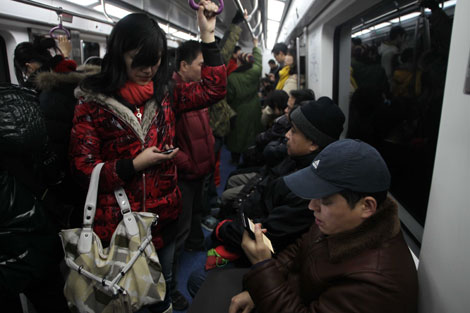 |
|
Subway passengers use cell phones to get information on their way to work. Most bus and subway services in major Chinese cities are fitted with audio-visual systems that display travel information and advertisements. Experts say mobile media is changing the lifestyles and habits of many Chinese residents. Photos by Wang Jing / China Daily |
Boosting brands
Fortune Global 500 companies like Procter and Gamble and Unilever are making regular investments in mobile television advertising.
Last October, online clothing retailers Vancl began running two commercials on screens in public transport systems in Beijing, Shanghai, Guangzhou and Chengdu. Featuring actress Wang Luodan, the advertisement spots helped increase sales revenue from 600 million yuan ($90.5 million) in 2009 to more than 2 billion yuan in 2010.
Although other factors such as a products expansion also contributed to the company's success, the influence of the commercials should not be underestimated, says vice-president Yang Fang.
 |
|
Passengers on a bus watch a mobile television screen during their commute to work in Beijing.Photos by Wang Jing / China Daily |
Since its founding in 2007, Vancl has advertised in magazines and online. However, instead of pushing products, the mobile television spots focused on brand marketing.
"We believe everyone should have access to well-made fashion," says Yang. "To achieve this goal, we need to constantly target Vancl customers at everyday places. Due to modern lifestyle, that means buses and trains."
Shanghai UKI Enterprise also reaped the benefits after branching out into mobile television advertising on subways in Beijing, Shanghai and Shenzhen. As one of the largest maternity dressmakers in China, the company started running commercials for its O.C.T. Mami brand in 2009 fronted by popular Taiwan talk-show hostess Xu Xidi.
Traditionally, maternity wear is advertised in hospitals on maternity and pediatric wards, yet Shanghai UKI president Zhao Pu insisted on reaching not only pregnant women, but also their husbands, parents, in-laws, friends and colleagues.
The idea has achieved significant results over the past two years, says marketing director Zheng Meng.
Sales revenue increased by 100 to 200 percent (sales at its outlet in the Nextage department store in Shanghai were estimated to hit 400 to 500 million yuan by the end of 2010), while the company's market share has increased dramatically in Beijing and Shanghai.
Money matters
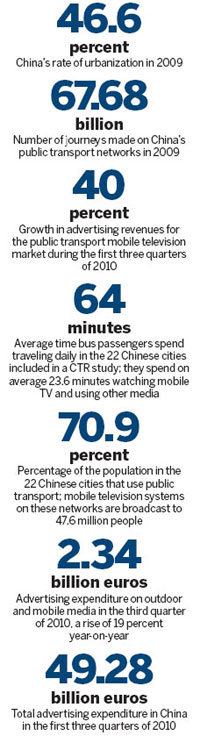
Total advertising expenditure in China in the first three quarters of 2010 rose 14 percent from the previous year, reaching a record-breaking $64.53 billion, according to figures from CTR.
|
|
During a conference in Dalian, Liaoning province, on Nov 30, its vice-president Tian was sat next to representatives from L'Oreal and Proctor and Gamble. He says both planned to increase their advertising budgets in 2011 and asked for advice on where to put the extra money.
Although companies are stepping up television marketing efforts, the cost-efficiency of the medium is declining, with the rise in viewers lagging behind the increased advertising tariffs. Advertising on mobile television only costs 30 to 40 percent of the price.
Research by Towona found an advertisement will influence consumer behavior effectively if it is broadcast on mobile television 32 times a day during rush hours for at least 21 days.
Meanwhile, a 2009 survey by Sinomonitor International showed that after China Merchants Bank advertised its new credit card on mobile television, 70 percent of the audience says they had a more favorable impression of the bank and 38.6 percent says they would apply.
The consumption power of the audience of mobile television is neither too high nor too low, according to CTR, therefore in recent years many companies have continued to increase investment in outdoor advertising, which includes mobile television commercials. In the third quarter of 2010, advertising expenditure on outdoor and mobile media rose 19 percent year-on-year to $3.07 billion.
Today, many advertisers are reaching beyond mobile television to a much wider mobile media market.
Considering China has 420 million Web users, including 277 million who go online using cell phones, Vancl will be looking at more mobile communication and marketing tools this year, says vice-president Yang.
"Mobile and Web media will have an explosive effect in the future," she says. "We think highly of them in terms of popularity, platform compatibility and communication capacity. We will definitely give priority to them."
How to use cell phones to make an innovative breakthrough still remains a question, she added, but in the meantime the company will keep using large LCD screens as a platform.
"Our customers are mainly young people born in the 1980s. They like dynamic and glowing new things," added Yang. "As an online company providing fashion products, we are willing to try out new media and wait anxiously to see how much it will affect us."
E-paper

Ear We Go
China and the world set to embrace the merciful, peaceful year of rabbit
Preview of the coming issue
Carrefour finds the going tough in China
Maid to Order
European Edition

Specials

Mysteries written in blood
Historical records and Caucasian features of locals suggest link with Roman Empire.

Winning Charm
Coastal Yantai banks on little things that matter to grow

New rules to hit property market
The State Council launched a new round of measures to rein in property prices.