AdS move with the times
Updated: 2011-01-14 11:13
By Jiang Xueqing (China Daily European Weekly)


 Twitter
 Facebook
 Myspace
 Yahoo!
 Linkedin
 Mixx
Mixx
 |
|
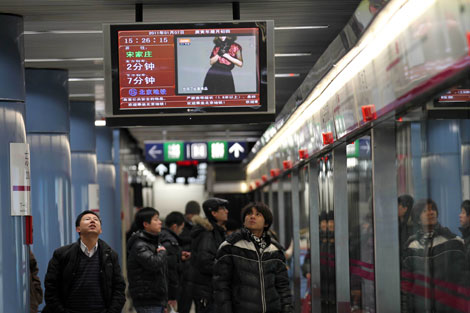
Commuters on a Beijing subway platform check out the rolling commercials that appear with notices about the next train. For the first three quarters of 2010, advertising revenues for the public transport mobile television market grew by 40 percent from the same period in 2009, according to market research firm CTR. Wang Jing / China Daily |
Major brands invest in mobile television to tap into China’s huge commuter market
Zhang Siyang is rarely without his iPhone. He uses it in the mornings to check the weather forecast and read the news headlines. He uses its GPS function for work. And when he's bored, he uses it to listen to downloaded music or read a book. "It makes my life more convenient,"says the 28-year-old Beijing photo editor. "Now I can do lots of things while I'm out and about."
Public servant Chen Jing also gets her information on the move. During her daily 45-minute commute to work, she not only uses her cell phone for updates but also the small television screens now in most train carriages.
The number of people now accessing mobile media on a daily basis in China has soared since 2007, according to CTR, a key market research firm in China.
The shift has already boosted advertising revenues for companies targeting commuters, and the best is yet to come.
"Within the next three to five years, existing channels for Chinese consumers to receive brand and product information will have revolutionary changes," says CTR vice-president Tian Tao.
"New media, including mobile media, will be mainstream."
The evolution of mobile media has been helped greatly by changes in the lifestyles and habits of the Chinese audience.
People today spend more time traveling from A to B and have shorter time periods in which to digest information, explains Liu Huizhao, general manager of media strategy at CTR. They are also online 24-hours a day.
However, the biggest lift has arguably come from China's rapid rate of urbanization, which hit a high of 46.6 percent by 2009, according to a report by the Chinese Academy of Social Sciences (CASS).
More than 20 million people became urban residents each year between 1996 and 2005, before dropping off to about 15 million between 2006 and 2009.
CASS figures show China's urban population is now double the size of the entire United States population.
The influx has put huge pressure on the cities' public transport networks, which has increased congestion and led to commuters spending more time traveling.
To cope with demand in recent years, the central government invested heavily. In 2009, people made roughly 67.7 billion journeys on 370,640 public transport vehicles over routes totaling 209,249 kilometers.
Most of those buses are now fitted with audio-visual displays to attract commuters' attention.
 |
|
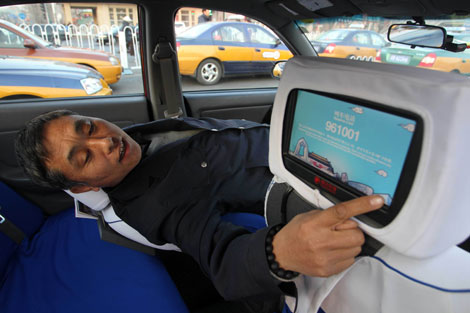
A taxi driver demonstrates how to use the touch-screen service in his car; passengers on a bus watch a mobile television screen during their commute to work in Beijing. Wang Jing / China Daily |
Getting onboard
In 2002, Shanghai became only the second city in the world to launch a mobile television network on buses (Singapore was the first), with similar projects trialed in Beijing two years later.
Today, services are available in most major cities, including Guangzhou, Wuhan and Nanjing.
"With mobile TV, people can watch and get the latest information anywhere at any time," says Wang Hanyu, director of investor relations at VisionChina Media, one of the country's largest digital television advertising networks for mass transport systems. "It greatly satisfies the demand for information by our fast-paced society."
With government support and the development of communication and broadcast technologies, the market for digital mobile television is entering a mature stage, he says.
CTR data for the first three quarters of 2010 shows advertising revenues for the public transport mobile television market grew by 40 percent from the same period in 2009.
According to a recent CTR survey in 22 major cities, almost 71 percent of the population uses public transport, with mobile television broadcast to 47.6 million people every month. On average, passengers spend 64 minutes on the bus daily and 23.6 minutes watching mobile TV and using other media.
The huge spending power of commuters has also made them prime targets for brand advertising.
An audience profile for mobile television drawn up by CSM Media Research suggests 66 percent are white-collar workers or mid- to high-level executives. They have good educations and stable jobs, with about 78 percent enjoying above-average monthly salaries. The average age is 37.
A growing number of advertisers are now aware of the commercial value of mobile television, with many using it to complement network television campaigns. Towona Media, another major digital television advertising network for mass transport systems, has more than 1,000 customers coming from various industries, including food and beverage, banking, pharmaceuticals, automobiles and real estate.
E-paper

Ear We Go
China and the world set to embrace the merciful, peaceful year of rabbit
Preview of the coming issue
Carrefour finds the going tough in China
Maid to Order
European Edition

Specials

Mysteries written in blood
Historical records and Caucasian features of locals suggest link with Roman Empire.

Winning Charm
Coastal Yantai banks on little things that matter to grow

New rules to hit property market
The State Council launched a new round of measures to rein in property prices.