The screening process
Updated: 2011-06-24 11:27
By Liu Xiaozhuo (China Daily European Weekly)


 Twitter
 Facebook
 Myspace
 Yahoo!
 Linkedin
 Mixx
Mixx
 |
|
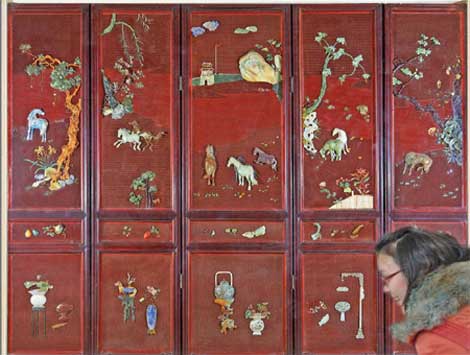
During the Tang Dynasty, artists began using folding screens as canvases to express their creative ideas. Chen Shu / for China Daily |
Folding screens are unique Chinese furniture first used by emperors and now by many
Imagine waking up one morning to find an exotic 80,000-euro treasure lying under your bed. This is exactly what happened to one American when he discovered beneath his bed, an Imperial Chinese folding screen, which fetched $117,300 (81,609 euros) at a recent antique auction. The man from Tallahassee had slept above this cultural relic for 20 years and still cannot remember how he got it.
The screen most likely made its way to the US via England and was loot raided from the Forbidden City by British troops sent to Beijing to quell the Boxer Rebellion in 1901.
Its special quality attracted strong interest among bidders, and shone the international spotlight on this unique form of Chinese furniture, which dates back to the Zhou Dynasty, almost 3,000 years ago.
Zhao Fuying, the chief editor of a traditional Chinese furniture magazine, says more Europeans are keen to add traditional screens to their collections.
"Because of the amazing technical skills and the deep cultural meaning in the artwork, traditional screens have gained more popularity among foreign collectors, who are fascinated about Chinese culture," Zhao says.
For the past century, the Chinese folding screen, minus the traditional artwork, became popular in the West as a room divider, which created a changing area in small one-room apartments.
But in the beginning, thousands of years ago, screens were exclusively used by the emperor and were a symbol of his power and high position.
They acted like a display board, and these grand, golden screens were usually placed behind the throne, and sometimes featured a painted fuyue, a large axe-shaped weapon, which manifested the mighty power of the supreme ruler.
As time passed, screens or pingfeng, became a regular feature in affluent households. By the Tang Dynasty (AD 618-907), they were widely used throughout the land.
The term pingfeng means protection from wind, which suggests the original purpose of the screen was to block drafts.
Today pingfeng is back in vogue for its distinctive Eastern elegance, as well as its practical function as an exotic piece of furniture that can act as a moving wall or divider, and create space in a room.
As screens become more popular, more furniture factories are producing them.
Wang Xiulin, a master of Chinese traditional furniture and professor of Beijing Forestry University, says there are 20,000 furniture factories in China producing traditional Chinese furniture, and screens have always been a popular export product.
The Beijing Longshuncheng Furniture Factory has a history dating back to 1862 and Ma Qingzhu is an engraver there.
Ma has been an engraver of screens for more than 30 years and learned her carving skills from her father, an old craftsman obsessed with traditional Chinese furniture.
She hopes the culture of traditional Chinese screens can be preserved, but says it takes a steady hand to produce the best products.
"A good engraver is made up of 30 percent carving skills and 70 percent of patience and care," Ma says.
Screen carving requires exact precision and a small variation in a cut can lead to the ruin of an entire screen carving.
Ma teaches young people how to make screens but worries that most of her apprentices may not stick with the trade.
"It is fortunate I have many young students interested in making traditional screens, but many of them cannot endure the hardship and patience of learning the craft," she says.
Ma says most screens are made from rare wood, such as yellow rosewood or red sandalwood and the most expensive screens are made from Hainan yellow rosewood, which is only produced in the island province of Hainan, in South China.
The subjects on screens vary and include figures and symbols that have an auspicious meaning, such as Chinese dragons, bamboo, the ocean and peony flowers.
However, patterns used on imperial court screens and those set up in a regular house were very different.
Zhao says that in traditional Chinese homes, safety of family members was top priority so images of vases were frequently used because the word "vase" sounded like "safety".
Imperial screens often had peaches engraved on their panels as a symbol of longevity, and were a prayer for the emperor to live a long life.
Zhao says that during the Qing Dynasty (1644-1911) craftsmen made an unusual and very untraditional move of carving passionflowers on screens.
"This species of flower was not native to China and just been introduced by the British," he says. "It reflected the cultural fusion that was happening between China and Europe.
"Here we had something, which was not a typical Chinese symbol, being carved on a very traditional piece of Chinese furniture."
In some cases, the panels were frames, which were decorated with silk and paper.
Painters and calligraphers added their works on screens and craftsmen used colorful stones, jade, pearls, bones, ivory and shiny pieces of metal for decoration.
Ma says from the decoration and the content of the screen, people can see the taste, personality and inner mind of its owner.
"Screens are also very practical," Ma says. "When one needs to create private areas, the screen can be used to create a room within a room. When more space is needed, the screens can be put away."
Traditionally in big Chinese homes, screens were set up near a bed to allow for privacy when someone is resting.
Wang Xiulin says that screens, in addition to practical use, permeate Chinese culture and reflect the lifestyle and personality of Chinese people.
"The perfect combination of screens with other furniture manifests a significant concept of classic Chinese philosophy, harmony," he says.
During the Tang Dynasty, screens became canvases for painters and poets to express their thoughts and emotions.
Folding screens, decorated with silk, fabric and rice paper, were often used in boudoirs, or dressing rooms, because they were not see-through and offered privacy when changing.
In fuedal China, the screen became more than just a decorative piece of furniture in an old Chinese home, and would double as a hiding place.
According to tradition, a single young woman of a rich family was not supposed to see or be seen by men other than her father, brothers or very close male cousins.
When a potential husband visited the family home, the daughter of the house might take a sneek peek at him from behind a screen.
Her father may talk about literature with the young suitor and might even ask him to compose a poem then and there.
If the composition of the poem and the man's appearance impressed the young woman and her father, she might agree to take him as a husband.
E-paper
Pret-a-design
China is taking bigger strides to become a force in fashion.
Preview of the coming issue
Franchise heating up
Party place
European Edition

Specials

Premier Wen's European Visit
Premier Wen visits Hungary, Britain and Germany June 24-28.

My China story
Foreign readers are invited to share your China stories.

Mom’s the word
Italian expat struggles with learning English and experiences the joys of motherhood again.