City soars to great heights with kites
Updated: 2015-08-07 09:28
By Zhang Zhao(China Daily Europe)
|
|||||||||||


|
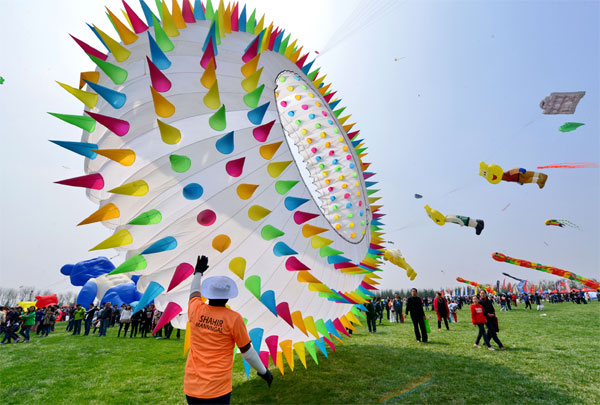
Various kites are flown at the 2015 Weifang International Kite Festival in April. Ju Chuanjiang / China Daily |
"The museum is a window through which we showcase the kite culture across the world," he says.
In Yangjiabu village, northeast of the Weifang city center, kites were originally byproducts of local woodblock New Year prints, a national intangible cultural heritage item that dates back some 600 years.
In the beginning, substandard prints were made into kites for children, and later, the bright colors and exaggerated figures of the prints became popular features of local kites.
Yan Kechen has been demonstrating how to carve woodblocks at Yangjiabu Folk Art Park for more than 40 years. He says his largest work took three years to finish, while regular-sized blocks require about five days.
Another master, Yang Junyou, has 50 years of experience in printing. He says the technique he uses is the same as used 600 years ago, except for the paint, which is a modern chemical product.
Although many people in the village can make New Year prints now, not all make a living from it. Yan says he has had about 30 students, but only two of them have become masters.
The village produces about 21 million New Year prints a year, many of them sold to more than 100 countries and regions overseas.
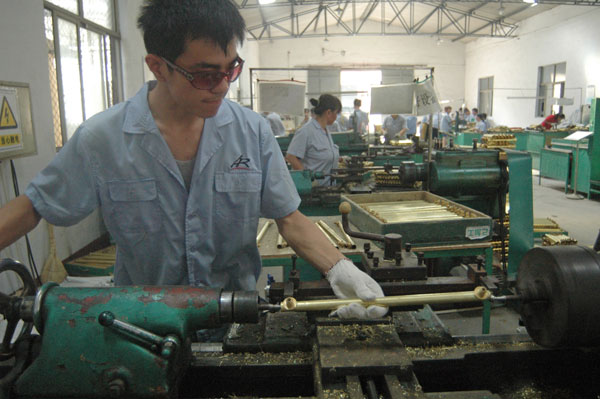
In contrast to Yangjiabu kites that focus on craftsmanship, kites made in the Wangjiazhuang area highlight practicality and industrialization.
The community, comprising four villages, was honored as the Chinese modern kite industry base by the International Kite Union in 2015. It has a total population of 4,650 people, about 2,200 of whom are involved in kite and kite component manufacturing businesses.
There are more than 80 kite factories in the area with an annual production capacity of 80 million kites and a revenue of 200 million yuan ($32.2 million).
"Many local people can make kites in the traditional way, but the handmade kites require much time and the profit is low," says Yuan Yan, chief of the community. "So 20 years ago, we started industrial kite manufacturing."
Yuan says an industry chain has been formed in the area, with local companies specializing in different parts of the kites.
Today's Top News
China rejects Philippine, Japanese, US claims on S. China Sea issue
MH370 passengers' families want more answers
'New Suez Canal' opened
for ship traffic
Trump won't rule out third-party run
China asks further probe into MH370
China's property taxes coming soon
Seven arrested for trafficking women into sex slavery in China
ROK's ex-first lady begins
DPRK visit








Hot Topics
Lunar probe , China growth forecasts, Emission rules get tougher, China seen through 'colored lens', International board,
Editor's Picks
|

|


|
|

|
|