City soars to great heights with kites
Updated: 2015-08-07 09:28
By Zhang Zhao(China Daily Europe)
|
|||||||||||


 |
|
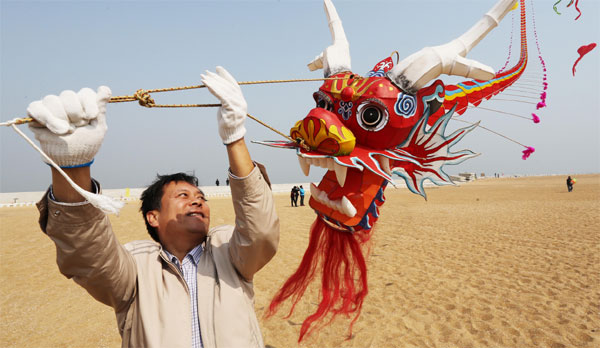
A man flies a dragon-head centipede kite at a kite contest in Weifang, Shandong province, in April. Zhang Chi/For China Daily |
In Weifang, Shandong province, kites are not just toys. They symbolize culture and industry.Widely known as the world capital of kites, Weifang has a history of flying kites dating back about 2,400 years.
Legend has it that the ancient Chinese philosopher Mozi made the first kite in the world in the Lushan Mountain area, which is now part of Weifang. It is said that the kite, made of wood, took him three years to finish but then fell and broke on the first day it was flown.
Others believe that the true inventor of kites was Mozi's contemporary, Lu Ban, a famous craftsman and engineer who has long been regarded as the patron saint of Chinese builders and carpenters. His kite, made of wood and bamboo in the shape of a magpie, flew three days before it fell, an ancient book records.
A statue of Lu stands in front of the gate of the Weifang World Kite Museum, the largest kite museum in the world.
Covering a total floor area of 8,100 square meters, the museum has a design that resembles the dragon-head centipede kite, the most famous Weifang kite pattern. The roof is made of blue glazed tiles with a ceramic dragon in the ridge, and the walls are covered in white mosaic patterns.
Built in 1987, the museum has more than 1,000 kites in its collection, most of which have been flown. They represent different schools of kite-making in both China and other countries such as the United States, Japan, South Korea and Southeast Asia.
One of the largest kites in the museum is about 140 meters long and features 108 portraits connected by a string, which are based on the characters in the Chinese classic novel Outlaws of the Marsh. The kite was first flown in 1985.
The smallest exhibits are no more than 5 cm long and visitors must use magnifying glasses to see them clearly. These miniatures use the same materials, techniques and patterns as the full-size models.
In addition to displays of kites, the museum has historical documents, models and videos depicting the history and culture of kites.
Even without wind, Li Naigang, vice-director of the museum, can fly a kite indoors. He does this performance with a specially made kite in the museum during his spare time.
He says he first saw indoor kite-flying in 2007 by an overseas team at the annual Weifang International Kite Festival. He then spent more than a year studying the techniques himself.
He said the museum attracts about 100,000 visitors a year.
Today's Top News
China rejects Philippine, Japanese, US claims on S. China Sea issue
MH370 passengers' families want more answers
'New Suez Canal' opened
for ship traffic
Trump won't rule out third-party run
China asks further probe into MH370
China's property taxes coming soon
Seven arrested for trafficking women into sex slavery in China
ROK's ex-first lady begins
DPRK visit







Hot Topics
Lunar probe , China growth forecasts, Emission rules get tougher, China seen through 'colored lens', International board,
Editor's Picks
|

|


|
|

|
|