Crackdown takes bite out of meetings
Updated: 2014-02-06 08:17
By Wang Zhuoqiong and Wang Wen (China Daily)
|
|||||||||||


|
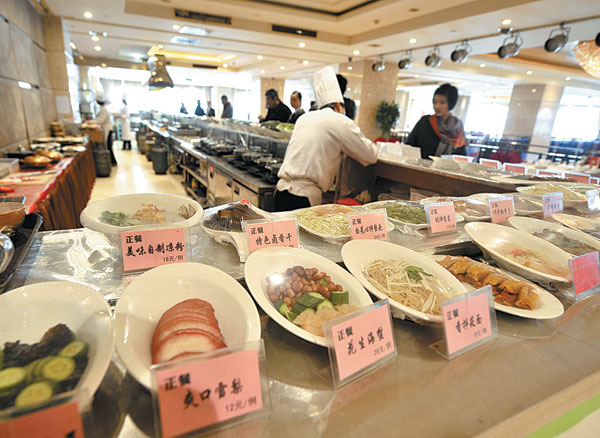
A high-end restaurant now offers low-priced dishes to customers amid the government move to crack down on lavish spending. [Photo / Xinhua] |
Wu said the government's austerity campaign has seen a change in customers in the conference and meetings market, from government dominated to enterprise dominated.
For example, January used to be the peak season for government-related annual conferences and meetings. But the implementation of the new policy has greatly lowered revenues at conference hotels, said Wu.
Beijing, Shanghai and Hangzhou in Zhejiang province, hosted the highest number of international conferences in 2012, the blue book said.
"These cities have good facilities, rich tourism resources and convenient transport, but industrial bases, plus the technological, cultural and educational resources are the most important factors," said Wu.
Beijing, Shanghai and Hangzhou in Zhejiang province, hosted the highest number of international conferences in 2012, the blue book said.
"These cities have good facilities, rich tourism resources and convenient transport, but industrial bases, plus the technological, cultural and educational resources are the most important factors," said Wu.
Zhong Bing, an industry insider who publishes Mice China magazine, said that for many hotels and service providers, revenue from government meetings, conferences and related businesses has fallen by nearly 70 percent. Conference centers and hotels that mainly target government meetings and banquets have been the most-severely affected, with a 90 percent decline in revenue compared with 2012.
Foreign-invested hotels and conference venues have also hosted fewer events. The reduction in spending on meetings and banquets from government departments and organizations and related enterprises is more visible in smaller cities because of stricter implementation of the policies, said Zhong.
"No official wants to risk their career for a lavish meal," he said. "In the era of Weibo (micro-blogging services) and WeChat (instant messaging services), any wrongdoings can be publicly exposed much more easily."
Zhang Yuan, a banquet sales manager at a five-star hotel in Beijing under a leading global hospitality chain, said that in addition to the declining number of meetings and conferences since the beginning of last year, the average spending has halved to about 100 ($16) to 200 yuan per person, per meal.
Government procurement, which does not include foreign-invested hotel brands, has sometimes considered their services, but since the implementation of the policy the average spend has almost disappeared, resulting in a loss in business revenue of nearly 20 percent, said Zhang.
Any government-related meetings and conferences have been conducted according to the principle of austerity, she said. "No flowers, no liquor, and fewer dishes. Meetings moved back to offices, and trips were scrapped."
To deal with the sudden drop in demand, Zhang's hotel has offered a reduction in banqueting rates to lure more customers. Even consumption at wedding banquets has been affected by the austerity campaign. "The first season of the year has seen almost no wedding bookings," she said. "Although we don't know how closely related that is to government policy, it's clear that an increasing number of people want a lower-profile event, rather than being the target of public blame."
The government initiated an anti-corruption campaign aimed at the medical industry in July, after conducting an investigation into the British pharmaceutical giant GlaxoSmithKline.
According to the public security authorities, since 2007 the company had used travel agencies to funnel at least 3 billion yuan in bribes.
But for many travel-service providers, crises such as these could help to consolidate the industry and phase out those who engage in illegal practices.
"The GSK incident and the government's austerity policies will help the MICE industry get back to normal," said Ma Xiaoqiu, deputy general manager of Grand China Mice, a services company launched two years ago, under the HNA Group.
The company's annual revenue was unchanged year-on-year and annual growth in 2012 was 20 percent. However, Ma is confident of higher growth next year, given the existing demand from enterprises.
"Meetings and conferences as a major channel for marketing and sales will remain unchanged," she said. "Companies will not cut spending. But they will hold events in a more transparent way."
This year, Ma has noticed that some clients have requested four-star venues instead of five-star, but often the conference halls in the smaller hotels are too small for the large number of attendees.
Ma also said that as foreign companies have moved their operations to second- and third-tier cites, from the eastern regions to western and central China, demand for venues in those areas is higher than ever before.
Today's Top News
US warns airlines about 'toothpaste bombs'
Dutch security services bug phones
President Xi leaves for Sochi ceremony
Vatican's child abuse record slammed
Schroeder accuses US of disrespect
US official's criticism over China's ADIZ unfounded
NHK's denial of history slammed
China reports 11 H7N9 cases






Hot Topics
Lunar probe , China growth forecasts, Emission rules get tougher, China seen through 'colored lens', International board,
Editor's Picks

|

|


|

|

|
|