Tackling a new financial reality
Updated: 2011-01-21 10:53
By Fu Jing (China Daily European Weekly)


 Twitter
 Facebook
 Myspace
 Yahoo!
 Linkedin
 Mixx
Mixx
 |
|
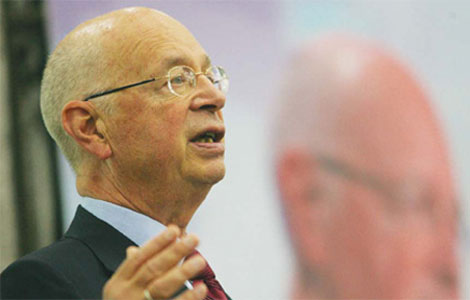
The annual meeting of the World Economic Forum, founded by Klaus Schwab, is scheduled for Jan 26-30 in Davos, Switzerland. Chen Feng / for China Daily |
Global leaders to converge in Davos next week to discuss state of the economy
Finding quick fixes to economic problems and taking forward the stalled talks on a global trade deal will figure prominently in the discussions between high-level politicians, central bankers and business leaders at the World Economic Forum (WEF) annual meeting in the Swiss ski resort of Davos next week.
While most of the deliberations may be focused on the much-delayed Doha negotiations for a global trade deal, recent trade trends and rising protectionism may also come up for discussions.
Identifying global challenges and finding fixes have been the themes of the annual Davos summits organized by the WEF. Set up in 1971 as the European Management Forum by German economics professor Klaus Schwab, it changed into its present name in 1987.
"The world has never been confronted with so many complicated challenges at the same time," says Schwab on the agenda for this year's Davos summit. The WEF will publish a report at the five-day conference highlighting the 34 risks confronting global economies.
This time around the conference will have four key discussion points. They include:
Responding to the New Reality which is a world with manifold power centers. It is also characterized by a high degree of volatility and the entrance (and exit) of players in the global race for competitiveness.
Discussing the economic outlook and defining policies for inclusive growth while a collapse of the global financial and economic system was avoided after having emerged from the hot zone of the crisis.
Supporting the G20 Agenda which is the most promising institution to define a new governance and multinational leadership model post crisis, despite well-known challenges regarding its legitimacy and mandate.
Building a global risk response mechanism in a world where systemic and natural risks cannot be avoided.
"We can do much better in terms of building both global and institutional capabilities around risk resilience, inclusive of risk awareness, preparedness, mitigation and response," says Schwab in a statement.
The organizers also expect to provide participants with strategic insights from the four thematic clusters, with the "Global Situation Space" among its defining legacies.
Particular emphasis will be placed on addressing the question of "how". In the true "Davos Spirit" participants will discuss the innovative ideas and solutions to global challenges in a multi-stakeholder environment.
International leaders such as UN Secretary-General Ban Ki-moon, Chairman of the European Central Bank Jean-Claude Trichet, and South African President Jacob Zuma are expected to be in Davos this time around. Adding a touch of royal color to the proceedings would be Britain's Prince Andrew, Sheikh Hamad Bin Khalifa Al Thani, Emir of the State of Qatar, and Prince Turki Al Faisal Al Saud from Saudi Arabia.
Top business luminaries such as billionaire investor and philanthropist George Soros, Yorihiko Kojima, chairman of Japanese corporate giant Mitsubishi, will attend the summit. Top US bankers such as Vikram Pandit and Brian Moynihan, the chief executives of Citibank and Bank of America are also going to be in Davos.
Dennis Nally, chairman of PricewaterhouseCoopers International will release the findings from the 14th annual PwC survey of 1,200 global business leaders on the key opportunities and challenges facing businesses.
Much of the discussions will also center on China and related topics. Though China is expected to send a high-level delegation for the Davos meeting, it is not clear as to who will be the leader. Premier Wen Jiabao and Vice-Premier Li Keqiang had attended the earlier Davos meetings.
"How China will transform its economic growth pattern and how the world will benefit from the transformation will be on my agenda," says Wei Jiafu, president and CEO of China Ocean Shipping Group Co.
Nariman Behravesh, chief economist at consultancy firm IHS, feels that the results of some drastic economic experiments would be seen in the next few years.
The main concern for China, according to Behravesh, is whether the renminbi would become a major reserve currency.
"The (Chinese) government is keen on elevating the status of the yuan. But it will be some time before the yuan achieves the status of the dollar, euro, yen, sterling, or Swiss franc," he says.
Behravesh, however, remained noncommittal on whether China can avoid a hard landing in the next few years.
The Chinese government's response to the global financial crisis consisted mostly of encouraging State banks to make massive loans to local governments. Unfortunately, most of these funds were used for real estate investments. Statistics show that the value of housing relative to GDP in China is now at the same level as that of in Japan in 1990 before its bubble burst, says Behravesh.
"The WEF this year is even more important than last year's," says Ben Verwayyen, CEO of Alcatel-Lucent, a leader in fixed, mobile and converged broadband networking, IP and optics technologies, applications and services. "We live in a new reality. The questions are more prominent than before."
Verwayyen feels that issues such as trade protectionism, the next Doha Round a more inclusive society and on how to get the new realities translated into decisions will figure prominently in Davos.
"We need to discuss serious issues with a flare of optimism, because whilst the crisis may be behind us in financial terms, lots of work still needs to be done and it will involve each and every one of us," he says.
E-paper

Ear We Go
China and the world set to embrace the merciful, peaceful year of rabbit
Preview of the coming issue
Carrefour finds the going tough in China
Maid to Order
European Edition

Specials
Mysteries written in blood
Historical records and Caucasian features of locals suggest link with Roman Empire.
Winning Charm
Coastal Yantai banks on little things that matter to grow

New rules to hit property market
The State Council launched a new round of measures to rein in property prices.