Culture in a cup
Updated: 2011-01-21 12:56
By Zhang Jing (China Daily European Weekly)


 Twitter
 Facebook
 Myspace
 Yahoo!
 Linkedin
 Mixx
MixxWang Xufeng, professor with the Zhejiang Agriculture and Forestry University, says: "China is the birthplace of tea and hometown of tea culture."
Wild tea plants were first discovered in China over 4,000 years ago and the Chinese people began to grow their own tea plants 2,000 years ago.
Yao Guokun, a senior researcher with the China International Tea Culture Institute, says: "Tea was first introduced from China to the Netherlands and Spain in 1652. The Princess of Portuguese who married the English King brought with her the habit of afternoon tea."
Yao says there has been a craze over Chinese tea culture worldwide since the 1990s. International tea culture institutes have opened up in the Netherlands, Switzerland and France.
"But most people will come to see Chinese tea performances and thinking this is it. Chinese tea culture is so much more than tea pouring, smelling and drinking," says Yao.
|
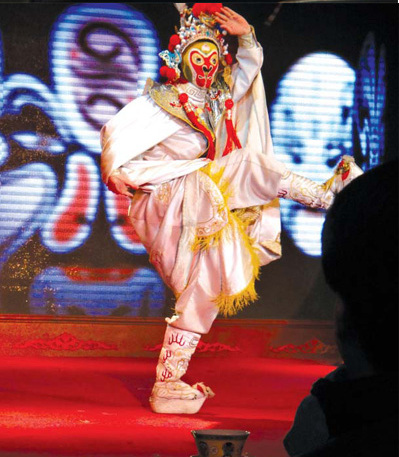 The face changing show performed at the Laoshe Tea House. Zhang Jing / China Daily |
"There are more than 10,000 Chinese poems on tea since the Tang Dynasty. The Dream of Red Mansions mentions tea in over 300 places in the novel. Chinese tea culture is reflected in historic relics, museums, tea houses, poems, movies and operas."
Wang says: "Tea houses in China vary in areas and each has its distinctive characteristics. Tea houses in Beijing have their traces with royal families, while those in Hangzhou are more for poets and artists."
The Laoshe Tea House, located at the southwest corner of Tian'anmen Square in Beijing, has been a must-see for VIPs including former US president George Bush, former US secretary of state Henry Kissinger and international kungfu star Jackie Chan.
Chan is said to be a fan of the "Taiji cheese" dish made with green tea powder at the teahouse. He
had five of them in a row and Laoshe Tea House has since placed his picture on a reserved seat to draw tourists.
Hundreds of tourists visit the teahouse daily to enjoy a variety of traditional entertainment such as conjuring, talk-shows and shadow-playing.
Shangshanglan, a high-end tea house situated next to the famous Mei-Lan-Fang Beijing Opera House in the financial area of downtown Beijing, has become a hot spot for entrepreneurs and Fortune 500 companies since it opened in 2009. It is said car giant Audi once held in the teahouse a lecture on perfume to about 40 of its clients to show its appreciation.
Ma Dafei, president of Shangshanglan, says: "Nine out of 10 advertising companies that did their pitches here won accounts. The account managers attribute part of their success to the quiet aroma of the teahouse which kept their clients in a better mood."
This is similar for a group of bankers and insurance brokers in Beijing who go to private tea classes regularly for meditation.
"The traditional art of Chinese tea also brings people closer to nature and helps you slow down," says Xie Yueping, a private tutor for the group.
Yao quotes Gilles Brochard, founder of a French tea club: "Tea is the most poetic of drinks. It is a culture that anyone can feel uplifted in."
E-paper
Pearl paradise
Dreams of a 'crazy' man turned out to be a real pearler for city
Literary beacon
Venice of china
Up to the mark
European Edition
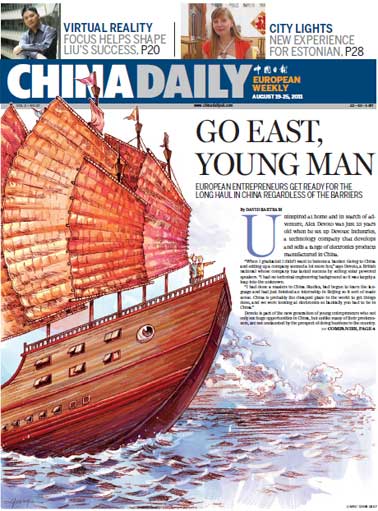
Specials

Power of profit
Western companies can learn from management practices of firms in emerging economies
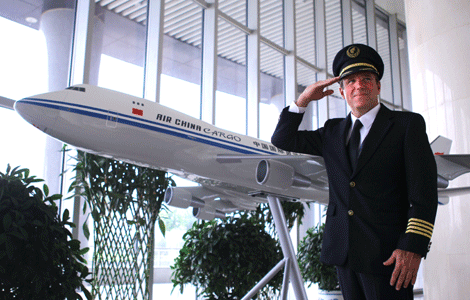
Foreign-friendly skies
About a year ago, 48-year-old Roy Weinberg gave up his job with US Airways, moved to Shanghai and became a captain for China's Spring Airlines.
Plows, tough guys and real men
在这个时代,怎样才"够男人"? On the character "Man"