Culture in a cup
Updated: 2011-01-21 12:56
By Zhang Jing (China Daily European Weekly)


 Twitter
 Facebook
 Myspace
 Yahoo!
 Linkedin
 Mixx
MixxTea remains an integral part of the Chinese experience for many
Where there is a Chinatown, there will most certainly be a kungfu martial art establishment. There will also most likely be a teahouse. For Luigi Bracchi, 62, president of Libera Accademia Di Belle Arti (LABA) in Brescia, and Huang Yanting, 30, a Chinese-Italian businessman in Florence, having the two Chinese elements together will be the perfect marriage.
Bracchi is a huge fan of Chinese tea. His top priority in the morning is to have a cup of green tea as soon as he wakes up. The habit is 20 years old now.
|
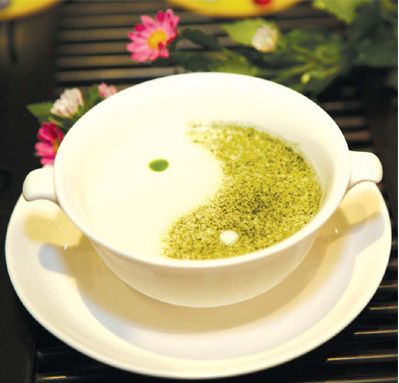 The "Taiji cheese" dish made with green tea powder at the Laoshe Tea House. Above: The face changing show performed at the Laoshe Tea House./Provided to China Daily
|
After he set foot in Hangzhou, capital of Zhejiang province, in 2007 and tasted Longjing tea, he would not try any other tea.
Huang migrated from Wenzhou in Zhejiang province to Italy at the age of 10 with his family, later opening a Chinese restaurant and garment shop in Florence.
Huang, currently the vice-president of the China-Italy Common Society in Tuscany, says: "Almost everyone in the world knows about Chinese kungfu, but to many, Chinese tea culture is still a mystery."
Marta Mascheroni, a student at the Universit Cattolica del Sacro Cuore in the Milan area, says: "My first Chinese tea experience is with chrysanthemum tea. It's like watching a flower blossoming in the water, which is fantastic. But that's all I know about it."
In Brescia, a city that lies east to Milan with a population of 1.5 million, a new Confucius Institute is set to help spread Chinese culture inside a 200-square-meter castle provided by LABA, also known as the Liberal Academy of Fine Arts, with a library and three classrooms.
Besides offering kungfu classes, Huang hopes the tea classes will attract about 200 to 600 students from the vicinity of Brescia.
For a start, Huang will have the 7,000-word Tea Script translated from Chinese into Italian. Tea Script, written by Lu Yu (AD 733-804) in the Tang Dynasty (AD 618-907), is considered by Chinese as the bible of tea.
Students will also learn ways of tea serving at Huang's class, the simplest of which will take about two weeks to grasp.
There are countless ways of serving tea in China and each is given a name associated with an ancient legend. One famous example is called "General Kwan patrolling the fortress". This is to move a teapot to and fro above six tea cups placed next to each other and pouring the tea evenly into each cup, mimicking a martial circumstance.
General Kwan Yu (AD 160-219), who used a 41-kg broadsword as his weapon, was a well-known figure in the period of the Three Kingdoms (AD 184-280).
The general, most noted for his dark red face and meter-long beard, later became a symbol of fortune and loyalty for Chinese people worldwide.
E-paper
Pearl paradise
Dreams of a 'crazy' man turned out to be a real pearler for city
Literary beacon
Venice of china
Up to the mark
European Edition
Specials

Power of profit
Western companies can learn from management practices of firms in emerging economies

Foreign-friendly skies
About a year ago, 48-year-old Roy Weinberg gave up his job with US Airways, moved to Shanghai and became a captain for China's Spring Airlines.
Plows, tough guys and real men
在这个时代,怎样才"够男人"? On the character "Man"