Big firms told to cough up more
Updated: 2011-01-07 12:45
By Zhang Ran (China Daily European Weekly)


 Twitter
 Facebook
 Myspace
 Yahoo!
 Linkedin
 Mixx
Mixx
|
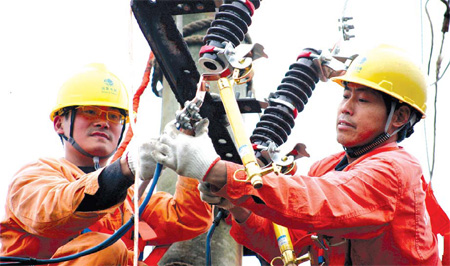 Workers of State Grid check the power transmission lines at a village in Guang'an, Sichuan province. State-owned enterprises such as State Grid are required to hand up to 15 percent of profits to the Ministry of Finance. Qiu Haiying / for China Daily |
A new requirement that requires State-owned enterprises (SOEs) to turn in a greater percentage of their profits to the central government will allow China to better support the public with an infusion of up to 50 billion yuan (5.7 billion euros), experts said.
The experts, most of whom have close ties to the government, said the new laws will also help curb "inefficient investments" by SOEs.
"The profits that SOEs have handed over before were comparatively low compared to their performances (now). The adjustment could give the government more budget to support social security and other public services," says Wen Zongyu, a senior researcher in SOE studies at the Institute for Fiscal Science, an organization affiliated with the Ministry of Finance.
In the new requirement, China's SOEs must hand over 5 percent more of their profits to the central government. The Ministry of Finance said in a Dec 30 statement that 15 SOEs in the resources and telecommunication sectors, including CNPC, Sinopec, CNOOC, State Grid Corp, China Tobacco, Shenhua Group Co Ltd and China Mobile, should hand over 15 percent of their after-tax profits to the ministry starting this year, up from a 10 percent requirement over the past four years.
Beginning this year, 88 large SOEs, including CHALCO, CNMC, COSCO, Air China, China Southern Airlines and China Merchants Group, will have to transfer 10 percent of their after-tax profits to the Treasury, up from the previous 5 percent threshold.
Thirty-three other SOEs, including China National Nuclear Corp, China South Industries Group and China Film, which were not previously required to hand in a portion of their profits, will begin delivering 5 percent of their after-tax profits in 2011, the treasury said.
The adjustment could allow the ministry to increase revenue by about 38 billion to 50 billion yuan, experts estimated.
"The move will certainly allow Chinese people to share more of the SOEs' profits after the rapid growth of China's economy," says Miao Rong, a researcher at China Enterprises Confederation.
Starting from 1994, the government suspended allowing SOEs to turn in profits because most of them were operating in the red due to poor performance. The government resumed receiving profits from SOEs in 2007. That year, about 147 centrally administered SOEs had a collective profit of nearly 1 trillion yuan after years of restructuring, capital injection, mergers and acquisitions and improvements in management.
Figures from the State-owned Assets Supervision and Administration Commission (SASAC), the watchdog of SOEs, show that profits of central SOEs rose 50.1 percent year-on-year to 802.26 billion yuan between January and November, while combined business revenue grew 34.7 percent to 14.9 trillion yuan in the period.
Central SOEs, with a total number of about 125 (the number of SOEs have been cut with continuing mergers and acquisitions), are expected to hit a profit of 1 trillion yuan in 2010, according to the SASAC.
"The key target of the SOEs' development during the 12th Five-Year Plan (2011-2015) is to improve their international competitiveness and influence," SASAC Minister Wang Yong says.
Wang said that SASAC will support up to 50 SOEs in their efforts to become leading global companies within the next five years, as 35 SOEs pledged to develop into global industrial giants.
Aside from the central SOEs, another 652 SOEs, mainly affiliated with the Ministry of Education, will be included in the budget system of managing State capital, which requires their expenditures being examined by national and local legislatures, the Ministry of Finance said in its Dec 30 statement.
"These SOEs affiliated with the Ministry of Education have been enjoying favorable tax policies and much less stringent regulations for a long time as they were regarded as part of the education system rather than enterprises. However, since they now totally operate under market principles, they should be examined and turn in their profits to the country," Miao says.
"Though the scale of these enterprises is not that large compared to central SOEs, the number of such enterprises is huge."
E-paper
Ear We Go
China and the world set to embrace the merciful, peaceful year of rabbit
Preview of the coming issue
Carrefour finds the going tough in China
Maid to Order
European Edition

Specials
Mysteries written in blood
Historical records and Caucasian features of locals suggest link with Roman Empire.
Winning Charm
Coastal Yantai banks on little things that matter to grow
New rules to hit property market
The State Council launched a new round of measures to rein in property prices.