How the west is being won
Updated: 2010-12-03 13:12
By Matt Hodges (China Daily European Weekly)


 Twitter
 Facebook
 Myspace
 Yahoo!
 Linkedin
 Mixx
Mixx
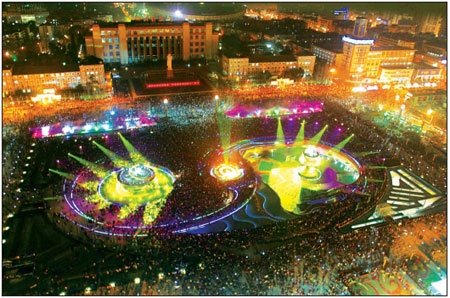
Chengdu's Tianfu Square at night. Below left: A Prado vehicle is assembled at the Chengdu Economic and Technical Development Zone. [Photo For China Daily]
Chengdu is poised to ride the next wave in China’s growth
Chengdu is likely to be among the world's fastest-growing cities in the next decade, Forbes predicted in October. And there are good reasons: Attracted by its lower operating costs - about one-third less than cities like Shanghai or Beijing - European companies are now switching bases to this portal to the Southwest China market, EU officials say.
"It seems to be a hot spot and the government is very welcoming," says Dr Ioana Kraft, general manager of the European Union Chamber of Commerce in China's (EUCCC) Shanghai office.
It is a sentiment Wang Xiaohua, business development manager for Belgian firm Sensornite, shares.
"The operating costs and employee stability are big draws for us," Wang says. The company opened an office in May and is planning to start two production lines in 2012.
"We can enjoy 20-30 percent cheaper operating costs than in Beijing, Shanghai or in the big coastal cities, and it's 30-40 percent cheaper to hire managers here. Renting a factory could be as much as 50 percent lower," he says.
Like other European companies sending out scouts to investigate the area, Sensornite benefits from the support of the locally based EU Project Innovation Center (EUPIC), which has "incubated" 30 companies since its launch in 2006, CEO Segree Dai says.
Some 177 Fortune 500 companies have invested in the city, including 34 from China, says Liu Jianing, a planning officer with the Chengdu Investment Promotion Agency. Of these, the United States accounts for the lion's share, but "European companies are catching up fast," he adds. Volkswagen is the biggest European investor.
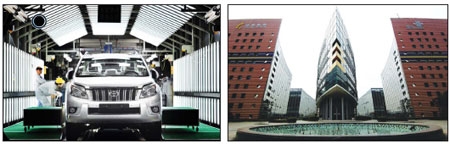
Left: A Prado vehicle is assembled at the Chengdu Economic and Technical Development Zone. Right: The Chengdu Hi-Tech Industrial Development Zone. Provided to China Daily
US firm Intel has invested $600 million (457 million euros) since it arrived in the Sichuan provincial capital in 2003, and Taiwan's Foxconn is awaiting government approval on a deal reportedly worth several times that amount. Growth is happening so fast, in fact, that some wonder if the city's infrastructure can keep pace.
"Chengdu is very proactive in improving their infrastructure, but it's a tough job to keep pace with the expansion of this city," says Paul Sives, chairman of the EUCCC's Chengdu chapter.
"The government is working on this," Liu says. "Soon we will introduce a smart transport system. Maybe in the future we will relocate more businesses away from the center and industrial pockets to the outskirts of the city, or to neighboring cities."
Sives says interest from Europe in the city is spiking. He has seen his members, which include those in neighboring Chongqing, grow from 85 to about 120 in the last 12 months, after witnessing similar growth the year before. The EUCCC's national membership now stands at 1,500, up from 51 when it first entered China 10 years ago.
"At the end of the day, there are more advantages than drawbacks. It really depends on what business you're doing, but overall I'd say the view (from our members) is 'come West'," he says.
On the ground, change is happening at such an accelerated pace - even by China's hypertrophied standards - that the buzz is contagious.
Chengdu opened its first metro line in October - one of nine planned, with at least two currently under construction - and has plans to build a new high-speed rail-link connecting it to Xi'an, a hub city in northwest China, next year.
It is building a second airport terminal and aims to introduce direct cargo flights to Los Angeles or San Francisco in the first or second quarter of 2011, to add to its 15 direct international flights. By 2013-2014, Chengdu will have a second international airport.
However the most exciting project is its New Tianfu City, an under-construction central business district (CBD) scheduled for completion in five years that looks set to trump its rivals in Beijing and Shanghai.
"I traveled around the world for eight years and I never saw anything like this," says Peter Kuppens, a manager at Maxxelli Real Estate, which helps clients such as Texas Instruments, BMW, Volvo and Aerobus relocate to the area.
The 37-square-kilometer project already includes a 1-million-square-meter software park and will be driven principally by the software and services outsourcing industries, Chendu's pillar industries along with IT and electronics.
Add to this: A financial services industry park, based on an investment of 10 billion yuan (1.15 billion euros), more than 10 five-star or super five-star hotels, international schools and hospitals, high-fashion outlets, gourmet dining and a New York-style nightlife - all defined by modernist and post-modernist architecture.
The new CBD is part of central government's ambitious Western-China Development Strategy, or "Go West" policy, which recently entered its second 10-year phase aimed at developing the country's inner western region for trade and commerce.
Some say it is better to come now, while the plan and the city's advantages are still cemented in place.
"The 10-year plan is great. But what happens after 10 years? You've got no guarantees," says Sives, voicing the fears of some of his members, as expressed in the EUCCC's business confidence survey for 2010.
He gave the example of "unpredictable" business tax rates, which were introduced in 2008 to offset the cost of the new infrastructure projects in the city.
Apart from its proximity to a Chinese consumer base of 250 million, what makes Chengdu the top destination in the region for European multinationals like Nokia, Siemens and Alcatel-Lucent is its business-friendly climate.
"What's very important is that, when dealing with the local government, they're very open to discussion," says Sives, who also serves as the general manager of Proton Products, which makes laser-based measuring systems for industrial application.
"The mayor of Chengdu, ever since I've been here, has had quarterly meetings with all the foreign-invested enterprises, and they tend to respond very quickly to issues."
Another selling point of the city is the loyalty of the local workforce and the higher quality of life, officials say.
The city has a turnover rate of 7-8 percent a year, compared to 20 percent a month in coastal cities, where "young people jump jobs for an extra five yuan", says Li Ming, deputy director of the project promotion section (foreign capital) at the bureau of investment services in the Chengdu Hi-Tech Industrial Development Zone.
Foreign firms are lured by the talent at their disposal - Chengdu churns out 100,000 new university graduates each year - as well as the incentive packages the high-tech park and city government offers, he says. These include corporate income tax rates with preferential rates almost two times better than those offered by other top-tier Chinese cities.
"In the last two or three years we've been attracting more multinationals," Li says. "We think we can keep these advantages for at least another 10-20 years."
However as the city grows, so does its even bigger neighbor, Chongqing, a municipality that separated from Sichuan province in 1997 and now ranks as the world's largest city.
Ford, Microsoft and Hewlett-Packard have bases in Chongqing - just a two-hour train ride from Chengdu - which posted GDP growth last year double that of China as a whole.
Chongqing's Two-River New Zone project was ratified in May of this year - making it the third zone in China after precursors in Shanghai and Tianjin to offer preferential policies for land, finance, taxation, investment and trade. It is gunning for over 1 trillion yuan of industrial output and GDP of more than 500 billion yuan, or one-quarter of the city's total, when it is completed by 2020.
"Chongqing is our biggest competitor, because the leaders there are getting more aggressive in terms of providing more incentives," Li says.
For now, though, Chengdu retains its edge. It is developing its auto industry at such a frenetic pace that even other cities in China are left bemused. Only Beijing and Shanghai now have more privately owned cars on the road in China.
"Chengdu is emerging as an auto-manufacturing city in China, and the speed of its growth is stunning other (Chinese) cities," says Liu, adding that the plant VW started in 2009 has an annual production capacity of 600,000 vehicles alone.
"Five years ago our auto industry was very low, almost blank," he says. "It is easy for investors to find partners here, so growth is snowballing."
Foreign investment in the city is 10 times higher than it was a decade ago, with an annual growth rate of around 30 percent, Liu says. Firms don't seem overly perturbed by the area's history of natural disasters, such as the 2008 Wenchuan earthquake or this summer's flooding, neither of which had a major impact on Chengdu.
Dell, the second-biggest supplier of computer systems in China, announced recently that it plans to set up its second flagship site in the country here next year for manufacturing, sales and services to support its rapid business growth in the region.
But the looming behemoth project for Chengdu comes in the shape of Taiwan's Foxconn, the world's largest producer of electronic components.
Foxconn, which was accused of "mistreating" its employees in the wake of a workers' suicide scandal at its Shenzhen base earlier this year, is already producing iPads in Chengdu. Now government approval is pending for an estimated $2-billion investment in the city, which would see Foxconn employ more than 100,000 people next year in just the first stage of its plan.
One of Chengdu's selling points is its slower pace of life, and easy access to water parks and its surrounding mountains, which cast the city in light cloud for much of the year, but which also act as a gateway to lush green belts that have earned the region the nickname "the green heart of China".
City planners say they are relocating heavily polluting companies out of the city center to the suburbs as part of their green dream, and turning away companies that do not meet their environmental emissions standards.
"This can also be a bonus for European companies as they usually have an edge over Chinese firms in this area," Sives says.
Kuppens says Chengdu's city planners are not just out to produce a carbon copy of other top-tier cities in China, but are bent on going one better.
"They can learn a lot from the mistakes they made in the eastern regions, and they have," he says.
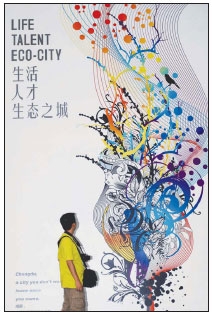
A poster at a booth promoting the Tianfu Software Park in Chengdu, capital of Sichuan province. Photo For China Daily
E-paper

Ear We Go
China and the world set to embrace the merciful, peaceful year of rabbit
Preview of the coming issue
Carrefour finds the going tough in China
Maid to Order
European Edition

Specials

Mysteries written in blood
Historical records and Caucasian features of locals suggest link with Roman Empire.
Winning Charm
Coastal Yantai banks on little things that matter to grow
New rules to hit property market
The State Council launched a new round of measures to rein in property prices.