Xi: Reject zero-sum mindset
Updated: 2015-12-04 08:21
By Fu Jing, Lan Lan, Tuo Yannan in Paris, Cecily Liu in London, and Gao Shuang in Brussels(China Daily Europe)
|
|||||||||||


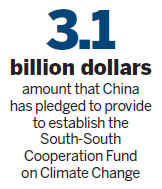
China has pledged to provide 20 billion yuan ($3.1 billion; 2.9 billion euros) to establish the South-South Cooperation Fund on Climate Change to support other developing countries in coping with climate change.
Xi also said ecological projects would be featured prominently in China's 13th Five-Year Plan (2016-20). He says China would help developing countries set up 10 low-carbon pilot zones starting next year.
Dennis Pamlin, founder of the Sweden-based consultancy 21st Century Frontiers, says Xi has set an example for other global leaders in expressing their climate commitments.
"Xi's call to abandon a zero-sum mindset worldwide, if others have heard and take action, is perhaps the most important change that must happen in global climate work," Pamlin says.
That would require the world to rethink many of its current tools and governance structures, from offsets to carbon taxes, and also to challenge many of the old polluting companies that today are very reluctant to reduce emissions, he says.
"We need to focus more on companies that see reduced emissions as a business opportunity. Citizens should be the focus, not old companies, unless they can show how they help citizens live better lives with zero emissions in the near future," Pamlin says.
Samantha Smith, leader of the World Wildlife Fund's Global Climate and Energy Initiative, also says Xi's call is a good reminder that all governments need to recognize that climate change is a global crisis and requires a collective and global effort.
"If countries only consider their own national interests and are not willing to compromise, this will only result in a winners-losers scenario, which is not in the interest of the common future of humanity and the planet," Smith says.
As for Xi's call for developed countries to honor their commitments to help poor countries, Pamlin says there are two barriers.
One is that many countries today are in a difficult economic situation. "The second barrier is a tactical one. Developed countries feel that as soon as they pay something, there are many other things that developing countries will ask for," he says.
"As developed countries have not done a good job in delivering on their promises, tech transfer and better trade policies in relation to developing countries, they want to wait as long as possible to focus the negotiations around a relatively simple issue."
Pamlin says China's leadership in South-South cooperation is very promising and if the quality of the projects is high, this should provide a role model for global cooperation.
Today's Top News
Merkel refuses cap on number of refugees
China mulls court services in English
Climate talks move slowly
Fosun chairman Guo Guangchang unreachable
Putin, Cameron discuss Syria crisis, anti-terror fight
11 children drown at sea
Unregistered citizens to finally gain recognition
Aging population could shrink workforce by 10%








Hot Topics
Lunar probe , China growth forecasts, Emission rules get tougher, China seen through 'colored lens', International board,
Editor's Picks

|
|


|

|
|

|