

Artist who captured a legend
Photographer pays tribute to iconic Hollywood actress with portraits snapped a year before her death
Fifty-four photos by Chinese artist Wang Xiao Hui, including her two portraits of legendary actress Audrey Hepburn, were on display recently in Shanghai.
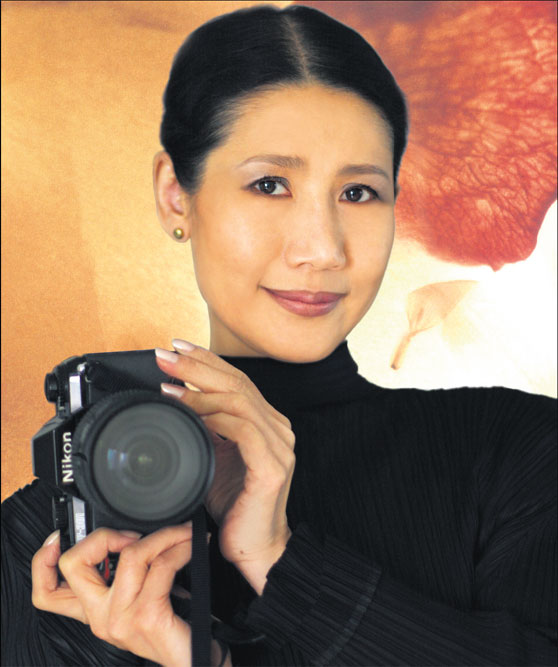
Wang is an international award-winning artist, author and professor with Tongji University who splits her time between Shanghai and Munich. The exhibition, at 503 BEA building in Lujiazui, featured her most iconic works from the past decades. All the portraits on display were showcased for the first time.
|
A black-and-white picture taken by Wang Xiao Hui of legendary British actress Audrey Hepburn in 1992. Photos Provided to China Daily |
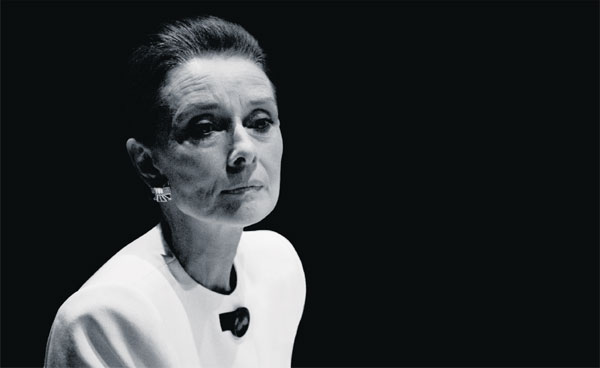
The portraits of Hepburn were taken in Munich in 1992, a year before the film star died. Wang was then studying filmmaking in the German city. The British actress is the only celebrity Wang has ever photographed.
"In 1992, the Chinese film Ju Dou was featured at an international film event in Munich, and the director couldn't make the trip to Germany," recalls Wang, who ended up being the representative from the Chinese film industry to introduce the film on German TV.
"It was on that occasion that I was introduced to Audrey Hepburn, and a mutual friend recommended me to take pictures of her. I loved her for her striking beauty, inside and out, unhampered by wrinkles or other signs of aging. To me she was not a goddess but more like an angel," she adds.
Wang took about two dozen photos of Hepburn but only the two showcased at the exhibition were printed because most of the slides were damaged during developing.
"The pictures were cut in the middle by accident," she recalls. "Now we have Photoshop, and it is very easy to fix a simple problem like that. You couldn't have imagined something like this at that time."
Wang was born in Tianjin in 1957. She graduated from Tongji University in Shanghai, majoring in architecture, and went to Germany in 1986 with her husband, Yu Lin, as visiting scholars. There, Wang became intrigued by photography and filmmaking, resulting in her making the switch from architecture to art.
Her husband was supportive, helping her with the logistics and chauffeuring her on her shooting trips. It was during one of these trips, to Prague in 1991, that they had a car accident. Wang was severely injured. Her husband died.
After waking from a coma, Wang took out the camera and turned the lens to her injured face. She went on to take pictures of herself, the hospital, medical staff and friends who visited. Art accompanied her recovery and helped her live through this difficult time of loss.
Wang says this experience marked a turning point in her life, as she found new meaning to her existence and was determined to become a professional artist. She has since made several documentaries and art films and has taken pictures that have been published and exhibited internationally.
German art critic Manfred Schneckenburger once said that Wang was "an icon of progress for the younger generation, despite the Chinese consciousness of tradition".
Gu Zheng, a Chinese critic, described her self-portraits as "most brutally honest" while contemporary art curator Victoria Lu compared Wang to the iconic Mexican artist Frida Kahlo because of her "continuous record of her life".
In 2001, Wang published an autobiography titled My Visual Diary, which was highly popular. The book is still in print. That same year, Wang became a professor at Tongji University. She founded the Xiao Hui Wang Art Center in 2003.
Throughout her career, Wang has worked with international brands and local governments in China on art projects as well as crossover initiatives. In 2012, the government of Suzhou, Jiangsu province, invited her to turn a historical residence into the Xiao Hui Wang Art Museum. The museum features a 400-year-old courtyard that occupies a space of 1,600 square meters along the historical Pingjiang Road.
Wang recalls that a lot of work had to be done to set up the museum.
"There were very strict regulations on the protection of vintage buildings. You couldn't knock down any of the walls and you couldn't even hammer a nail into them," she says.
As part of the redesign of the property, Wang added a glass roof to a part of the garden, which made new media projection possible. She also changed the main gate to face the pedestrian street. The project was such a success that it was named by a German institution as one of the 15 most beautiful private museums in China.
For five years, the center hosted art events, performances and exhibitions before it was returned to the Suzhou city government.
In 2016, the CEG Xiao Hui Wang Art Space opened in Shanghai, showcasing her creations as well as those from young emerging artists and designers.
zhangkun@chinadaily.com.cn
|
Chinese artist Wang Xiao Hui is an international award-winning artist, author and professor at Tongji University. |
(China Daily European Weekly 08/17/2018 page22)