

Sharing the healing touch
TCM doctor tells of passion for promoting tuina therapy through demonstrations and teaching
Over three decades, Li Zhengyu has promoted tuina - a form of manipulative therapy that is part of traditional Chinese medicine - in about 20 countries.
One of the 59-year-old's recent destinations was Dubai, and he plans to fly to either Canada or Germany later this year to showcase the effectiveness of the therapy.
|
Tuina doctor Li Zhengyu (center) demonstrates how to apply pressure between joints to remove blockages along the meridian points. Gao Erqiang / China Daily |
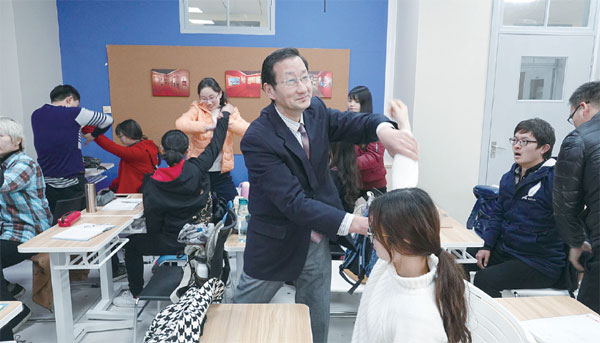
"TCM should be the choice of therapy for illnesses around the world and not just in China," says Li, who works as a tuina doctor at Yueyang Hospital Affiliated to Shanghai University of Traditional Chinese Medicine.
Based on principles that are more than 2,000 years old, tuina involves using hands to apply pressure in areas between joints to remove blockages along the meridian points and stimulate qi, or the body's natural energy flow, to promote healing.
It can be traced back to ancient China and is often used in conjunction with acupuncture, fire cupping, herbalism, tai chi and qigong exercises.
"This therapy is more convenient than acupuncture, which requires disinfected needles and medicinal alcohol, and is safer than Western medicine, which may have side-effects," says Li.
"Tuina can be done using clean hands anytime and anywhere, and this is why an increasing number of foreigners are becoming interested in it. Foreigners who visit Yueyang Hospital have always been amazed at how tuina could be used to heal different conditions like cervical spondylopathy or frozen shoulders."
Li, who completed his bachelor's, master's and doctoral degrees in acupuncture and tuina at Shanghai University of Traditional Chinese Medicine, says his passion for this field was influenced by his mother, who was a professor at Shanghai Medical College of Fudan University.
While Chinese herbalism and acupuncture were the most popular specializations among medical students in the 1980s, Li decided to pick tuina instead because he felt it was a new field of medicine that held much promise. His interest in the discipline has since led him around the world.
During one of his trips to Japan in the 1990s, Li administered a five-minute tuina treatment to a Japanese nurse and immediately relieved her of her pain in her right shoulder. The nurse was so impressed with Li's skills that she visited him in China seven years later. This time around, she requested that he treat her left shoulder.
In 2007, when he visited Mumbai as a member of a Shanghai municipal government delegation, Li performed a similar feat, this time on an Indian official suffering from neck pain.
Apart from his duties at the hospital, Li is also a professor at Shanghai University of Traditional Chinese Medicine's acupuncture and tuina school. There, he teaches Chinese herbalism, tuina and acupuncture courses in English to local and international students who major in Chinese medicine. More than 40 overseas students have majored since 2012.
Li also gives tips on how the therapy can improve their everyday lives. For example, rubbing the zhongwan acupressure point on the stomach before lunch can help to reinforce the spleen and promote digestion.
Sheikh F. Elahee, a Bangladeshi who is majoring in acupuncture, moxibustion and tuina in the PhD program at Shanghai University of Traditional Chinese Medicine, says he enjoys Li's lessons as "the lecture materials are well-prepared, referenced and exhaustive".
Veerachaz Soottitantawat, a doctoral student from Thailand, shares the same sentiment. In fact, he has been so inspired by Li that he is planning to become a TCM teacher after graduation.
"During his classes, we often get to practice tuina and hone our critical and independent thinking in order to solve problems, and this enhances the learning process," he says.
Back home in Dhaka, the capital of Bangladesh, Elahee is spreading awareness of TCM through his acupuncture and tuina clinic, which was set up in 2015.
"Many patients have come to my clinic to receive these therapies and they have been grateful for the results. Previously, little was known about TCM in my country, but now it is getting more popular," says the 54-year-old.
Another skill that is key to helping him further promote TCM to the rest of the world, says Li, is the ability to effectively communicate with his international students. The doctor says he is still constantly trying to improve his English.
Li admits that he once found it difficult to translate TCM terms from Chinese to English but was lucky enough to have the help of his wife, Wang Qi, a professor who teaches doctoral students English at Fudan University.
Today, Li is so proficient in his second language that he at times works as an interpreter for the International Conference on Acupuncture and Tuina, and for foreign visitors at the Shanghai Chinese Medicine Museum.
He is also involved in a project by the World Health Organization to develop standardized terminology for Chinese medical practices.
"Being able to accurately pronounce English words is important, otherwise my foreign students would not be able to understand what I'm teaching. I may be their TCM teacher, but my foreign students are also my English teachers," he quips.
caochen@chinadaily.com.cn
(China Daily European Weekly 06/15/2018 page14)