

Running in China, training in Africa
The marathon boom in China has become a launching pad for thousands of African athletes' careers. The long-distance races, which are gaining popularity due to the number of participants and the quality of the elite participants, are offering unique opportunities for up-and-coming athletes to build their profiles and transform their lives back home.
Marathons have become more competitive globally, with relatively unknown African runners being overshadowed by state-sponsored and world-acclaimed athletes in the major marathons, including those in Berlin, New York and London. As a result, many have been left facing a bleak future.
Races in China, however, have become game-changers. Elias Makori, a journalist with 25 years' experience in sports journalism, says quality road races and marathons, big prizes and blossoming Sino-African relations have made China a great destination for African amateur athletes.
|
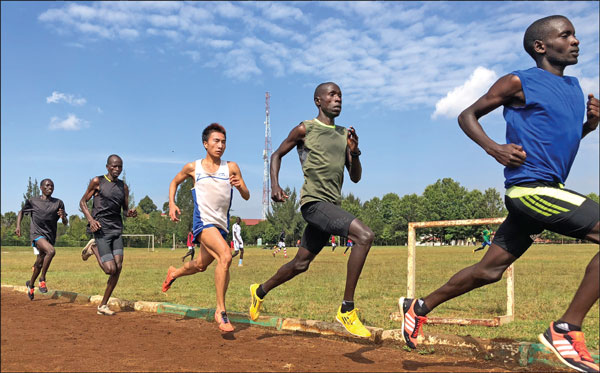
Chinese and local athletes at Tao camp during training on Aug 21 at the training field owned by Moi University. Provided to China Daily |
|
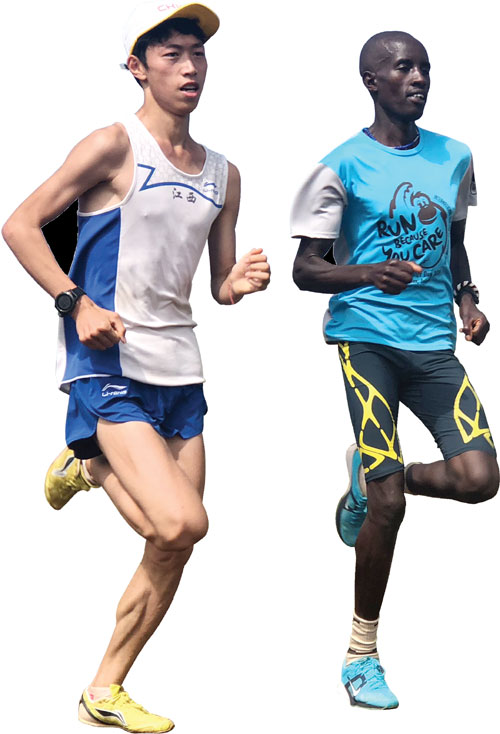
A Chinese athlete and a local athlete at Tao camp. Provided to China Daily |
"In particular, the IAAF Gold Label races such as the Xiamen, Yangzhou, Beijing and Shanghai marathons and the Jianzhen Half Marathon have seen Kenyans and Ethiopians flocking there because these races offer great quality, pay well, and also pay the athletes who win, most of them Kenyans, promptly," he says
Media reports indicate that China's marathon industry grew by 20 percent in 2017, reaching a value of around $20 billion, according to China Athletics Association. More than 1,100 distance running events were held in China in 2016, 256 of which were hosted or co-hosted by the sport's governing body. The total number of participants in these events reached 4.98 million. There are five International Association of Athletics Federation Gold Label races in China, as well as three silver label and four bronze label races.
Over the last 18 years, there has been an upswing in the number of African runners participating in China. Last year saw a 26-year-old Moroccan, Salah Eddine Bounasr, clinch a win at the 37-year-old Beijing Marathon, with an Ethiopian and a Kenyan trailing behind. Bounasr had won the Guangzhou Marathon the previous year. The IAAF Gold Label Road Race saw an Ethiopian, Melesech Tsegaye Beyene, extend the nation's winning streak in the women's race to four years.
Another IAAF Gold Label race, the Shanghai International Marathon, saw a South African, Stephen Mokoka, and Ethiopian Roza Dereje retain the men's and women's titles, respectively, coming away with $45,000 each. The four top places were dominated by Kenyans and Ethiopians, who went home with prizes of no less than $6,000 - big money in two countries where average GDP per capita is $1,500 and $800, respectively, according to 2016 data.
Wang Qifan, a manager working at Tao Camp - owned by Tao Shaoming, the former coach for China's national women's distance-running team - says 20 athletes from eastern Africa participated in the Beijing Marathon last year, earning $20,000 for finishing the course.
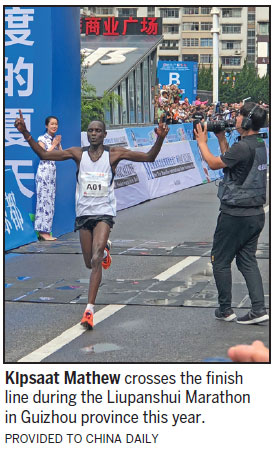
"At least 10 African athletes took part in medium-level events, held in Shanghai, Guangzhou, Shenzhen and Chongqing. In low-profile races, including those held in Guiyang and Liupanshui, both in Guizhou province, the bonus for the champion was 10,000 yuan ($1,500; 1,260 euros; £1,140), says Wang, who is based in Kenya.
Just as China's marathon boom is relatively new, so is Africa's participation. Wang says that, despite marathons being held in China for more than four decades - including the Beijing and Great Wall races - Africa's participation only became noticeable from the year 2000. Interestingly, this was when the Forum on China-Africa Cooperation was first launched in Beijing, four years after the Beijing Olympics.
"I think Kenyans had very little information about offerings in China," says Tekla Chemabwai Sang, a retired sprinter and middle-distance runner from Kenya who is currently studying at Moi University in Eldoret, Kenya. "Besides, there were no agents promoting China, and thus Kenyan athletes only knew of European meets," she says.
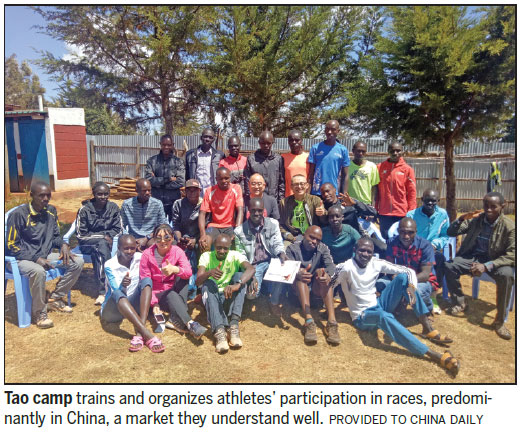
This has gradually changed. With three training camps, one in Kenya and two in Ethiopia, Tao Camp is representing more than 100 athletes in these two countries. It trains and organizes athletes' participation in races, predominantly in China, a market they understand well. "But we also register them in the US and Europe, too, since these are more mature markets," says Wang.
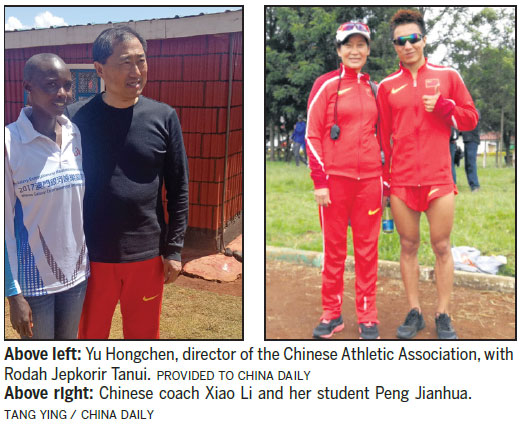
The youthful manager has witnessed the transformation that bonuses earned in China can bring to rural Kenya. Rodah Jepkorir Tanui joined the camp five years ago when she was only 18, motivated by poverty at home and with few prospects of pursuing the further education that would probably have improved her employment chances. She and her three siblings put time and energy into their training and were soon on their way to China to compete.
She took part in three races annually and, though the earnings were not high, she was able to sustain her family back home and pay for her training. She and her siblings have managed to buy three parcels of land for their parents and build a stone house that stands out amid the mud-walled homes in rural Kenya.
"These changes come from their own hard work and trust in us as their agent," says Wang.
Kenyan world champions have started taking note of China. Two-time world half marathon champion Geoffrey Kipsang Kamworor, who won his debut marathon victory at the prestigious men's New York City Marathon last year, says China is entering the world marathon stage. The runner, who also won the World Cross Country Championship in 2015 in China, says the conditions are right for elite athletes to enter road races there too. "Upcoming runners are competing in China, not only for the rewards but to build their names. This is important, especially in recording good speeds, since organizers of majors consider this seriously," he says.
While Kenyans are visiting China to compete, Chinese athletes are setting up camp in Kenya to train with the champions. Statistics show that Kenyan marathon runners now boast 11 of the 12 fastest times set worldwide. Several researchers have attributed their success to their genes, since many of them hail from the Kalenjin community, located in a high altitude area. Others put their exemplary performance down to their childhood experience of running long distances to school. However, poverty and a drive to improve their lives - coupled with discipline and focus - are the key reasons, according to former sprinter Chemabwai. "Kenya also has many role models in the long-distance field, unlike many other countries," she says.
Kipsang concurs, saying that China's runners have realized the benefits of training with Kenyans. "I think they will make it and will get a lot of experience and improve their performance," he says, adding that although Kenyans come from humble backgrounds and started early, the Chinese athletes only need fortitude and self-discipline to improve their performance.
He has noticed that many of his compatriots are traveling to China to compete, saying the Chinese presence in Kenyan training camps has increased the visibility of their country. "We are working together, training together and I believe this is a good bridge of cooperation," he says.
In 2015, Italian coach Renato Canova led 16 members of China's national women's middle- and long-distance running team to train in Kenya's high-altitude area in preparation for the 2015 World Athletics Championship held in Beijing.
Kipsang's sentiments are echoed by Eliud Kipchoge, multiple Olympic medalist and considered one of the greatest marathon champions of his era, who says a lot is happening in China. He participated in a one-week Nike-sponsored tour in the country last year, where he met with coaches and junior athletes. He says he was amazed by the facilities and the management of sports in China. Comparing the two countries, he says: "The Chinese are really working hard using state-of-the-art facilities, unlike Kenya, where we are working hard without facilities. Nevertheless, Kenyans have altitude and good terrain, especially dirt roads that build endurance and strength."
He says that technical exchanges between the two countries will improve marathon running. He dismisses fears that Kenya is giving away its secrets, saying talent is inborn. "One only needs to train hard, be disciplined and have the right attitude," he says.
Kipchoge says the Sino-Kenyan partnership in athletics can leverage innovation and technology, in which China has an upper hand. "Chinese marathons have opened more opportunities for Kenyans," he says. "China is a big market in sports and there are many marathons held there. It has indeed opened more opportunities for Kenyans, and young runners can hone their talent while earning money."
Despite the growth and success of athletics globally, challenges continue to gnaw at the subsector in Africa. These include foreign agents failing to pay their proteges, burning them out by registering them in consecutive races and encouraging the use of banned substances to enhance performance.
On the subject of swindling naive athletes out of their dues, Kipchoge says he is yet to learn of any such case from China. However he notes that the relationship between a sports agent and an athlete is based on trust. "The Chinese managers are also registered by national federations, so I believe they are responsible. Life is about taking chances."
Wang notes that failing to give an athlete enough recovery time is dangerous for their long-term performance. "This time varies with individual athletes and it may take three to four months before they start training for the next meet. This is critical when registering them for competitions."
Doping allegations have dogged the Kenyan athletes since an expose by German investigative journalist Hajo Seppelt that revealed rampant use of banned performance-enhancing substances, especially by Kenyan and Russian athletes. In 2014, the Kenyan government sought help from China, Norway and the World Anti-Doping Agency to revive the dormant Kenya Anti-Doping Agency.
Patrick Sang, a renowned Kenyan coach who has built the careers of countless champions, including Kipchoge and Kipsang, says that although there are no tangible partnerships with China at the moment, he hopes to pursue stronger ties in the near future. "We want a partnership that would promote and strengthen the sport sector in Kenya. Perhaps one area in which Kenya and Africa can benefit is in specialized training for field events and sprints."
He co-trains the Chinese athletes currently in Kenya. At the training field owned by Moi University, about 45 minutes from downtown Eldoret, the main town in Uasin Gishu county, the three athletes and two coaches train hard. According to Xiao Li, Kenyan athletes are more determined to win. They consider a race a shortcut to riches and a means of improving their families' circumstances. They are eager to run and have a passion for participating in and winning races, and therein lies the benefit of training with them. "After 20 days of partnering with them, my student Peng Jianhua has improved on his speed," says the coach.
Xu Song, another coach, concurs, saying the training atmosphere drives the Chinese athletes. "The inexperienced athlete here runs faster than our best," says the coach. "The Chinese athletes take the training passively. Here, you see the young people are enthusiastic about the sport. They run together, train and compete with each other, thus improving their speeds rapidly. In China, only a few young people like this sport, and many parents do not encourage their children to enter this field because it has nothing to do with the entrance examination for higher education."
Xu Pengcheng, from Yantai, Shandong province, says he is in Kenya to train in the high-altitude areas. The athlete, who arrived on August 1, says the difference between Chinese and Kenyan runners is that, despite the relatively poor facilities, circumstances have made the Kenyans stronger and they want to changes their fortunes.
"I have been told that most of the big villas here belong to marathon athletes," says Xu.
Wang is looking forward to receiving the Chinese national team when its members prepare for the Tokyo Olympics in 2022. He hopes he will make champions out of them and build more role models who will transform the subsector back home.
China has produced world champion athletes, the most successful being Liu Xiang, the former Olympic and world champion and record holder in the 110-meter hurdles, China's first Olympic track champion and an iconic role model.
Contact the writers at lucymorangi@chinadaily.com.cn
(China Daily European Weekly 08/31/2018 page1)