

Takeover heralded a bright future
When Chinese company bought ailing lighting importer for a bargain price, it was the start of a remarkable success story
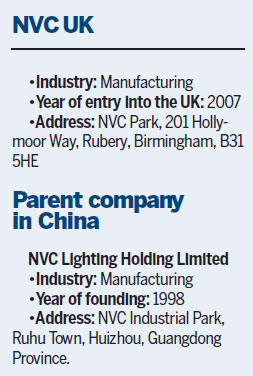
In 2007, the Chinese lighting company NVC acquired a British lighting import company that was experiencing financial troubles.
The purchase, for only £100,000($133,600; 113,720 euros), was a bargain buy, considering there was already £300,000 worth of lighting stock sitting inside the British company's warehouse. In addition, NVC also gained the British company's sales team, established sales channels in the UK and intellectual property relating to a collection of light designs. Fast-forward just over a decade, and NVC's UK team has expanded to the point where it employs more than 90 people. Annual sales in the UK and Europe have reached £30 million. Its clients include Tata Steel, EasyJet and Marks& Spencer.
|
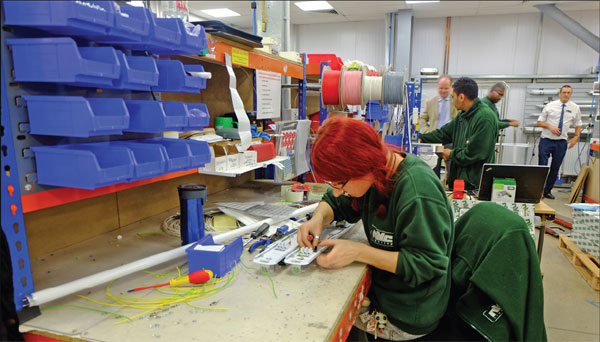
A worker assembles lights in NVC's Birmingham factory. Photos by Cecily Liu / China Daily |
|
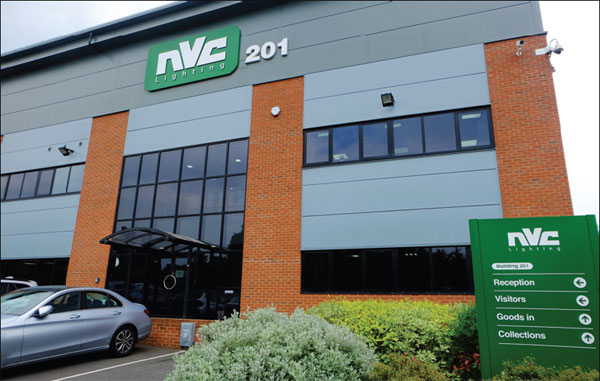
NVC's factory in Birmingham. |
The company also has an ambitious target of doubling sales over the next four years, an outcome that would put it among the UK's handful of "tier-one" lighting equipment makers, such as Zumtobel, Dextra Lighting and Whitecroft Lighting.
In the UK's £1.5 billion to £2 billion lighting market, tier-one players are characterized by having revenue ranging from £50 million to £150 million. NVC currently sits in the tier-two bracket, alongside the likes of Ansell Lighting and JCC Lighting.
Perhaps more significant than sales figures, NVC has made a name for itself in the UK as a reputable brand. Today, 80 percent of the lights it sells in the UK and Europe are NVC's own branded products. In comparison, NVC only made lights as an original equipment manufacturer for other brands when it first entered the UK.
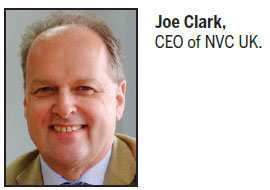
"Over the past few years, the lighting industry's perception of 'made in China' has significantly changed, thanks to the growth of high-quality LED lights manufactured in China," says Joe Clark, CEO of NVC UK.
"Because China's LED production and quality has risen so much over the past few years, customers feel more comfortable knowing we are a Chinese company, as rival companies most likely outsource their LED production to third-party manufacturers in China anyway," Clark says, sitting in his spacious office above the company's expansive warehousing and assembly facility.
According to figures gathered by Beijing-based Forward Intelligence, China's share of global LED light production grew from 27 percent in 2013 to 37.1 percent in 2017.
LED stands for light-emitting diode. Compared with traditional incandescent lighting, LED lights use at least 75 percent less energy and last 25 percent longer.
In the UK and European markets, NVC enjoys the advantage of "vertical integration", Clark says. Whereas other competing lighting companies outsource production to China, NVC sells lighting products made in its own factories in China to UK and European customers.
This means customers' requirements will be better communicated to the research and development and manufacturing teams. In addition, vertical integration cuts out the margins for middlemen, so NVC is able to give customers more value for their money.
"We are very proud of the fact that we are now a well-known and respected company in the UK lighting industry. We explain to our customers about our Chinese roots, and how that generates benefits to them. They feel it makes sense."
Meanwhile, the team of 200 R&D engineers at NVC's China offices has contributed to the company's cutting-edge innovative lighting production, and NVC is now introducing these technologies to the UK market.
In the second half of this year, NVC will supply a smart lighting system to the Kent Police call center which will help night shift workers to better adjust their biological clocks to the demand of sleeping during the day and being awake at night.
Kent Police will become one of the first public organizations in the UK to adopt this type of smart lighting system.

Another key advantage that NVC enjoys in the UK as a Chinese company is its unique opportunity to communicate with Chinese companies developing large-scale commercial and residential building projects in the UK, with a view to directly entering their supply chains.
The first such project that NVC has secured is to supply the lighting system for a £1.7 billion business park on East London's Royal Albert Dock, developed by the Chinese developer ABP, which began earlier this year.
NVC's and ABP's shared Chinese roots helped ease communication and cement trust, Clark says. Direct communication dispenses with margins for lighting wholesalers, to the benefit of both parties.
NVC, founded in 1998, is a company that grew rapidly from humble origins. Its founder, Wu Changjiang, started the business in Huizhou, Guangdong province, with just 1 million yuan ($158,600) of investment.
Wu, a self-made entrepreneur, grew the company quickly through the strategy of sharing rewards with suppliers, buyers and employees through financial incentives. He also put NVC's advertisements on highways and in other remote places, whereas his competitors followed the more traditional routes of advertising in lighting shops.
These brave steps proved effective and in its first year of operation, NVC achieved 30 million yuan in revenue. For the next few years, the company's sales grew by nearly 100 percent year-on-year. By 2010, the company was listed on the Hong Kong Stock Exchange, raising HK$1.37 billion ($170 million).
NVC's sponsorship of major events, including the Beijing Olympics in 2008, the Shanghai World Expo in 2010 and the soccer World Cup in South Africa the same year, provided great publicity.
The company focused on the industrial lighting sector in its early years, leveraging on China's high growth momentum, fueled by large-scale industrial construction. In more recent years, it has shifted to high-end residential building lighting as China's industrial development has slowed and the purchasing power of the country's middle class has increased.
However, the company's path to success has not been without challenges.
In 2014, NVC's founder Wu and the company's chairman, Wang Donglei, became locked in a power struggle, with Wu consequently being voted off the board of the company. Simultaneously, the police started investigating him for either embezzling or falsely obtaining loan guarantees of a significant sum without the knowledge of the company's current board. In December 2016, Wu was sentenced 14 years in prison for embezzlement.
He has since left the company completely, and NVC's operations have continued under the leadership of Wang. In 2016, the company generated revenue of 3.81 billion yuan, which makes it one of China's largest lighting companies.
The dramatic events in China certainly cast a shadow of doubt on the sustainability of its UK operation but, fortunately for NVC's British team, Wang and the management team in China have encouraged the UK team to continue its independent sales, research and assembly.
Over a decade of success for NVC in Birmingham has encouraged the parent company to continue eying international expansion. Last year, NVC established an office in Dubai, with a vision of eventually expanding it into a factory like the one in Birmingham. The Dubai team will seek to learn from Clark's team about its successful experiences.
However, Clark admits that leading the first and biggest overseas operation of such a large Chinese company is still a case of trial and error. One challenge is that much of NVC's cutting-edge lighting technology for new luxury apartments is too expensive for the UK market.
"Because NVC is such a big player in China's high-end residential new-build sector, it is a shame that we couldn't leverage on our headquarters' strength in a better way," Clark says.
But on a day-to-day basis, Clark is more worried about how to improve NVC's operational efficiency, warehouse management and motivatation of employees.
Walking around NVC's Birmingham factory, there are surprisingly few clues that the company is Chinese. More than 95 percent of its workers have been hired locally, and there are hardly any signs written in Chinese.
"We are keen to be a highly localized company, while enjoying the long-term vision and huge innovation and financial support from our parent company," Clark says.
cecily.liu@mail.chinadailyuk.com
( China Daily European Weekly 06/08/2018 page30)