


Sweet fruits of summer
Editor's note: Traditional and fusion cooking styles, regional and international ingredients and a new awareness of healthy eating are all factors contributing to an exciting time for Chinese cuisine. We explore the possibilities.
The spring displays of flowers are fading, but the fruits that come after them are already appearing in markets - and they are a colorful cornucopia.
In the north, there are cherries, peaches, sugar plums, apricots, hawthorns and melons ripening, while regions nearer the tropics are harvesting pineapples, lychees, longans, mangoes, pomelo, waxberries and cherry tomatoes.
Some of these may be familiar, but there are quite a few fruits that are very Chinese, such as loquats, longans, lychees, mulberries, hawthorns and that delicious tree berry, yangmei, or the waxberry, also known as yumberry.
They will ripen throughout summer, and it is a continuous feast right until autumn.
First to appear are the loquats, because they have lain dormant on the trees since last winter and were just waiting for the weather to warm and the rains to arrive to plump up and sweeten. They are tangy with a slightly tart aftertaste.
The Chinese believe they are ideal for that in-between spell between spring and summer, because loquats are good for itchy throats. They are traditionally used as an ingredient in cough syrups.

Fresh loquats have sticky skins and the secret is to scrape the fruit with the back of a teaspoon, bruising the flesh underneath the skin so the connective tissues break. Then the skin can be easily peeled off.
Yumberries, or yangmei, are less fussy, though equally tasty. The surface of the deep red fruit is like a firm and dense raspberry but at the center is a single seed. It is very rich in vitamins and is often used for juices and dried as a preserve.
The hawthorns are also ripening and their dusky red fruit will be harvested for jellies, sweets and that iconic Beijing snack, candied haw or bingtanghulu. The haw fruits may also be sliced and dried and then added to pickled plums for another signature summer drink, plum juice tea or suanmeitang.
Northerners also love cooking haws down to a sweetened thick jam, a relish that is often eaten with rich meats or mutton hot pots. That's because the haw is a strong digestive aid and is often used as a dieting supplement.
Dark purple mulberries are delicious but short-seasoned, but when they are in abundance, they are juicy and sugar-sweet. They are very fragile and don't keep well, and are best eaten fresh as soon as they come off the tree.
China has been eating mulberries ever since it started cultivating silkworms thousands of years ago. These days, cultivars produce both abundant leaves and fruits. The leaves are dried for tea and the dried fruit is an ingredient in traditional Chinese medicine prescriptions.
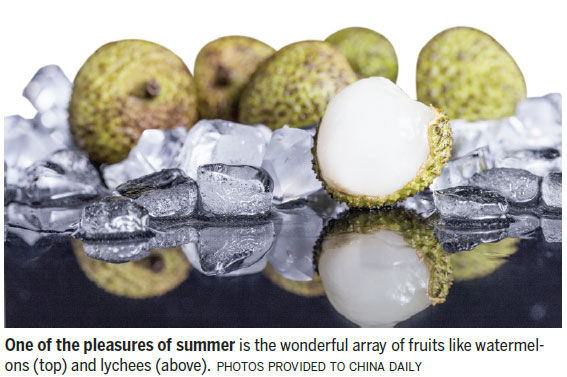
Of course, the queen of all summer fruits is the lychee, fragrant and sweet and enough to tempt a smile from a petulant concubine.
The Tang poet Du Mu once wrote this:
"A lone rider cuts through red dust, the concubine smiles, The lychees have arrived."
It was said that the Tang emperor Xuanzong's consort Yang Yuhuan loved lychees so much that he had a special relay of fast horses courier the fruit into Xi'an, the capital, just so he could see her smile.
Even now, the earliest lychees to hit the market are a variety named Concubine's Smile, feizixiao. Grown in Guangdong and Hainan, the red-green papery husks hide snowy white sweet flesh and very small seeds.
The fruit that follows fast in the lychee's footsteps is the longan, or dragon's eye. It is a refreshing fruit with purer flavors than the lychee's musky sweetness. The translucent flesh is also dried to a dark pulp, which is used in TCM as a cure for anemia.
In the southern provinces, mothers in confinement are fed a drink of dried longans and Chinese jujubes daily to help them recover from childbirth.
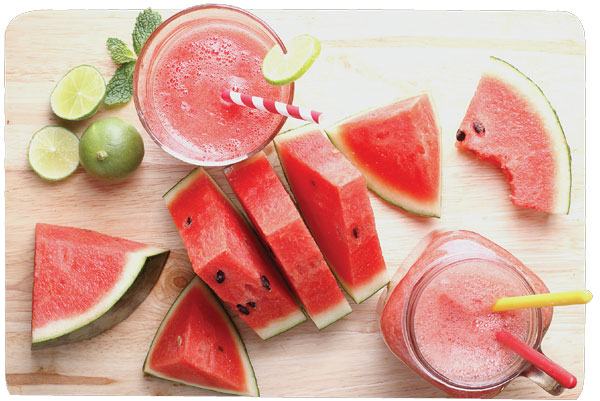
No summer season passes without melons. Watermelons are the ultimate coolers, and large, juicy globes cut into slices are a surefire way to combat heat and thirst.
I live near a suburb of Beijing where the sandy soil produces many watermelons every year. The farmers set up stalls just outside their farms and tempt drivers with their produce. My favorite is a little dark, striped seedless melon called Black Beauty.
Moving away from the temperate north, there are the more exotic offerings from other regions.
The Xinjiang Uygur autonomous region is famous for its yellow apricots, grapes and huge pomegranates. Xinjiang apricots are tiny, the size of a quail egg, but what they lack in size, they more than make up in flavor. They are now exported all over China, thanks to better logistics. The arid low humidity also allows them to dehydrate if left on the trees, shriveling up into naturally dried fruits.
In the south, in Yunnan province, there are the white pomegranates from Mengzi, pale pink fruits that are very juicy and hardy enough to be shipped to other parts of the country.
From the same region in the Red River Valley also come mangoes, bananas and papayas. The local pineapples are very sweet.
The best pineapples, though, come from farther south in Hainan Island, where bananas are also grown all year round.
Several varieties of pineapple are cultivated here. My favorite is a little one that is peeled on the spot and handed to you like a large lollipop.
China is a huge country with a large and varied geographical footprint, and one of the pleasures of summer here is the wonderful array of fruits available.
paulined@chinadaily.com.cn
(China Daily European Weekly 06/01/2018 page19)