


German cuisine: it's not just pork and sausages
A man who has taught the Chinese to appreciate bread puts more of his nation's food on the table
"Marriage is like visiting a restaurant: You always think you chose the best until you see what your neighbor got."
This wonderful morsel of thought can be found on a wall in Bodensee Kitchen, a restaurant in Beijing that offers rustic and European fare that is usually hard to find in these parts.
|
Bodensee Kitchen on Lucky Street in Beijing. |
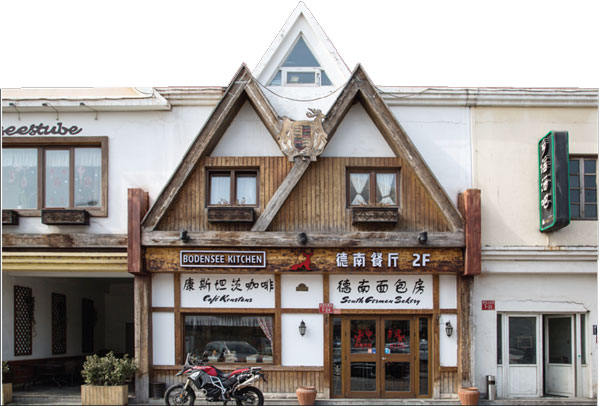
Bodensee Kitchen is on Lucky Street and shares an entrance with one of the first German bread makers in China, South German Bakery, which has been around for 12 years. Thanks to its German founder, Michael Paingt, these hard, dense and salty German breads, which most Chinese were either ignorant of or disliked, have gradually won wide appreciation.
Now Paingt has opened a full-fledged German restaurant in the place where he first started trading in Beijing 12 years ago, on the second floor of the bakery. Here you can enjoy German food, specifically German-Austrian-Swiss cuisine from his hometown of Bodensee (Lake Constance), located where Germany, Austria and Switzerland meet.
"The perspective of German food in China is a little bit boring," Paingt says. "Most people think what we eat every day is pork knuckle and sausage."
Of course, these two are quintessential dishes, and a dozen German restaurants in Beijing serve them, but Bodensee Kitchen tries to go further, he says.
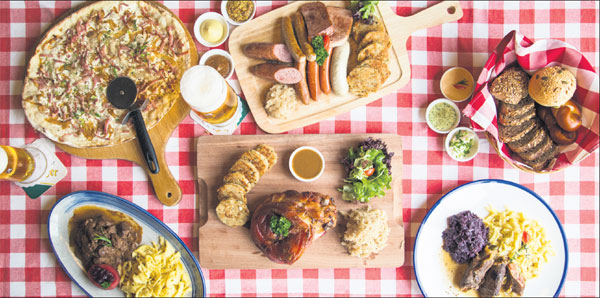
At a media tasting lunch, when we were invited to try a German pizza, it was difficult to know what to expect - but any expectations I did have were low, given the pictures on the menu, whose subjects looked anything but appetizing. What a surprise, then, when the "flammkuchen pizza" proved to be much more delicious than regular pizza, which can sometimes be bland.
We were served pizza with a paper-thin, crisp and blistered crust, topped with a layer of homemade sour cream and then bacon, onions and chives. The sour cream created a mildly tart, creamy contrast to the crust's crispness.
Paingt calls the dish Schwarzwald (Black Forest) pizza, because it comes from the region of southern Germany adjacent to the Alsace region of France.
Venison goulash with poached pear, cranberry sauce and spaetzle (handmade noodles) is another regional dish served by Bodensee Kitchen. The venison didn't quite cut it for me, but the hearty accompaniment of bouncy, soft egg noodles, which I had never eaten before, won me over.
Bodensee Kitchen does a good job of presenting a wide choice of traditional German fare, and it would be failing its duty if it did not serve sausages and pork knuckle.
"To many Germans, sausages represent a taste of home," Paingt says.
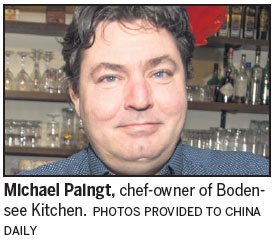
"Walk into a butcher's in Germany and you'll see 50 to 100 different sausages. Raw, boiled, air-dried, smoked, and so on, and with different spices. Every butcher has his own little secret recipe."
Bodensee Kitchen's sausage platter includes Nuernberger, Frankfurter, cheesekrainer and engadin sausages, as well as meatloaf, homemade sauerkraut, potato salad, pretzel dumplings and gravy.
Paingt talks about the meticulous process of making a classic roast pork knuckle. From start to finish, he says, this dish takes more than 36 hours to prepare, including brining for one day, then boiling for about five to six hours, until the meat is tender, and roasting until the skin is so crisp that it breaks into pieces at the cut of a knife with a little force. Inside, the flavorsome and tender meat simply falls off the bone.
The golden, crispy skin is sure to elicit crunches of delight.
Quality restaurants offering Western food are difficult to find in China, Paingt says.
"If you are looking at restaurants that offer homey European dishes, they are few and far between, apart from the high-end ones in the five-star hotels. Including drinks, I'd say the average cost per person here is 75 yuan ($12; 10 euros; £8.5) for breakfast, 80 yuan for lunch, and 150 yuan for dinner. That is about on a par with the price of a similar family-style restaurant in Germany."
Over the past 10 years, he says, he has worked on a number of food and beverage projects in Beijing and Shanghai, including consulting for successful brands such as O'Steak, Amandine, Enoterra and April Gourmet.
Bodensee Kitchen boasts an extensive menu. For drinks, there is a judiciously chosen selection of wines from Germany and Austria; German beer such as Bitburger draft beer, Weihenstephan wheat beer and Schofferhofer. For vegetarians, there are Schlutzkrapfen, Austrian dumplings that are stuffed with chopped spinach, garlic and a coating of nutty parmesan. There is also a menu for children.
Finally, I should mention the ample size of the dishes - which means that this cozy, brauhaus-style eatery is well suited to families and friends dining together.
dongfangyu@chinadaily.com.cn
|
Gourmets can enjoy German food, specifically German-Austrian-Swiss cuisine from Bodensee (Lake Constance) at Bodensee Kitchen. |
(China Daily European Weekly 04/06/2018 page19)