

Singing the praises of hanfu
Cultural ambassador for ancient clothing waxes lyrical over the appeal of apparel
Sun Yi reckons that nostalgia runs in his blood. He enjoys composing long, soppy songs about lost youth.
"I like listening to traditional folk songs and classical music, which has affected my work to a large extent," says Sun, 44.
When he was a student at Sichuan University in the 1990s, he tended to express his emotions through melodies and lyrics after teaching himself to play the guitar, he says.
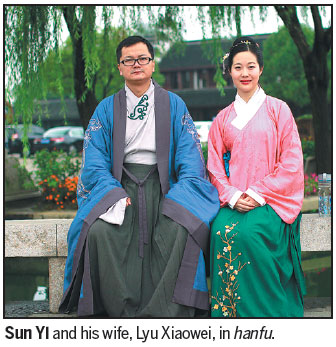
So who better to be an ambassador for that ultimate walk down memory lane, the hanyu movement?
Sun is well known among tongpao, aficionados of Han traditional clothing, for having produced a series of hanfu-themed songs and being a pioneer in opening stores selling hanfu in China.
However, 15 years ago, he was a little more mainstream, coming to wide public notice by composing and singing Xiao San He Xian ("Minor Triad"), a song that became popular online in China, and then landing a contract with a record company.
Though the reserved young man often seemed self-conscious in public, he says he actually found it easy to be in the public eye. His first songs, performed in talent shows, had won him popularity at his university and he used to sing part-time in bars.
After he graduated, he landed what many would have regarded as a highly desirable job with a State-owned company, but he threw that in a couple of years later to devote himself to singing and composing.
In 2004, after his success with Xiao San He Xian and signing the recording contract, he came across discussions about Han clothing on the online forum hanchc.com.
At the time, there was a debate in China about the need for a traditional garment embodying the uniqueness and antiquity of Chinese culture, in the same way that the kimono does in Japan and the hanbok in Korea.
People started to use the term hanfu to distinguish the traditional clothes of the Han from other ethnic groups and to discuss online the history and cultural connotations of hanfu.
"It sparked my interest in traditional stuff," Sun says. "As Han people, I felt we had responsibility to restore it."
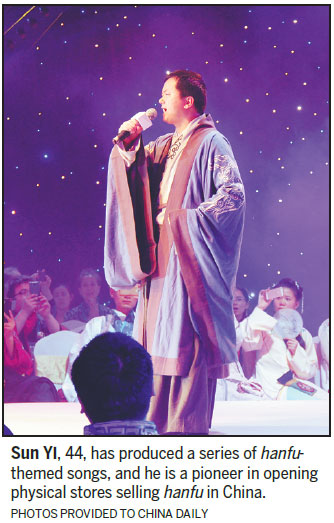
One day he saw a poem by a forum participant that impressed him, and he adapted it into lyrics and composed a hanfu-themed song.
For hanfu aficionados, that song, Chong Hui Han Tang ("Dating back to the Han and Tang dynasties"), a paean to their culture, became a hit.
Later he composed a series of songs related to hanfu that also struck a responsive chord with hanfu lovers.
Sun now insists on dressing in hanfu when he performs onstage, saying the attire bears the spirit and civilization of Han people.
His wife, Lyu Xiaowei, has also become a tongpao, and they opened a hanfu shop, called Chong Hui Han Tang, in Chengdu in 2006. It is believed to have been the first physical hanfu store in China.
Playing music is now a hobby, he says, while developing hanfu is "my inescapable duty".
The couple now own 18 stores across China and an online store on tmall.com, and last year the value of sales of 10 hanfu stores on the online shopping platform Taobao totaled 100 million yuan ($18 million; 14 million euros; £12 million), Sun says.
"I am very happy to have seen these changes over the past 10 years. As the government highlights the need for China to bolster its confidence in its culture and traditions, now is a good time to further develop hanfu."
xingwen@chinadaily.com.cn
(China Daily European Weekly 03/23/2018 page16)