

Branching out
Shanghai Pudong Development Bank official says expansion reflects 'importance of London as a global financial hub for the long term'
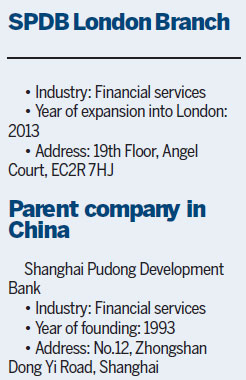
Shanghai Pudong Development Bank has expanded into London, riding a wave of increasing China-UK financial ties, thanks to the bilateral relations' "golden era" and high complementarity between the financial hubs of Shanghai and London.
The bank, which established a representative office in London in 2013, will formally host a branch launch ceremony in the near future. SPDB's London branch is the bank's first outside of the Asia-Pacific region.
|
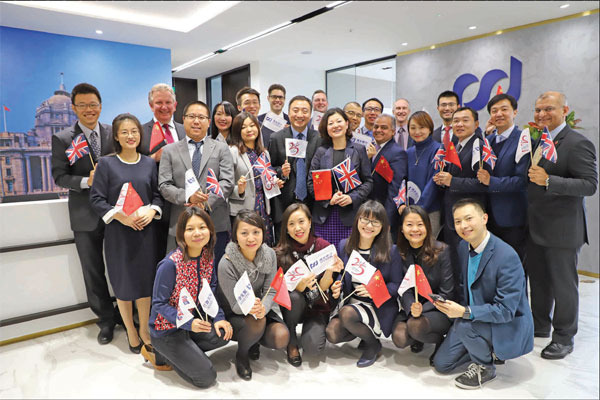
SPDB's UK employees gather at the bank's London office, located at the heart of London's Square Mile financial district. Provided to China Daily |
"Setting up a London branch is a very significant decision for us and an important milestone in our internationalization process," says Chen Xin, general manager of SPDB's London branch.
SPDB's initiative to launch a London branch follows five Chinese banks that already have branches in London: Bank of China, China Construction Bank, Industrial and Commercial Bank of China, China Merchants Bank and Bank of Communications.
Four of these banks established London branches in the past four years, which is testimony to Chinese banks' fast pace of international expansion as well as the attractiveness of London's role as a financial center and a springboard for Chinese banks to realize their global ambitions.
"We are fully confident about the importance of London as a global financial hub for the long term, due to its concentration of a diverse range of financial companies, experienced financial sector talent and investors from all over the world," says Chen.
The key reasons for the London branch's establishment are the bank's desire to leverage on the "golden era" of China-UK relations to support its existing Chinese clients' process of internationalization - particularly in areas covered by the China-proposed Belt and Road Intitiative - and to contribute to synergies between the financial hubs of Shanghai and London, Chen says.

The "golden era" of relations began in 2015 during President Xi Jinping's state visit to the UK, which gave fresh impetus to trade and financial collaboration.
China has made $18 billion of nonfinancial investment in Britain, more than in any other EU country. At the ninth UK-China Economic and Financial Dialogue in December, more than £1.4 billion ($1.9 billion; 1.6 billion euros) in business deals were signed.
Meanwhile, London's offshore renminbi activities are growing rapidly. According to data for the first quarter of 2017 collected by the Society for Worldwide Interbank Financial Telecommunication, 36.3 percent of global offshore renminbi exchange transactions were conducted through London.
SPD Bank was incorporated in Shanghai in January 1993 and was listed on the Shanghai Stock Exchange in 1999. Despite the bank's relatively short history compared with China's biggest State-owned banks, SPD Bank's growth is crucial to the rise of Shanghai as an international financial center.
Over the past 25 years, SPDB has gained a reputation as an innovative bank. For several years, it has been ranked among the Top 100 listed companies in China by the Hong Kong-based media group Asia Weekly, and in 2017 the British magazine The Banker ranked SPDB 18th in its Top 500 Banking Brands list.
The Banker also put SPDB 27th by Tier 1 capital in its Top 1,000 World Banks 2017 list. Tier 1 capital is the core measure of a bank's financial strength from a regulator's point of view, as it plays a key role in protecting a bank against unexpected losses.
Since SPDB has just celebrated its 25th anniversary, Chen says her team in London is eager for new achievements.
"Inspired by the incredible achievements of SPDB in the past 25 years, all the staff of SPDB London will continue to strive for the prosperous future of SPDB," she adds.
The imminent launch of SPDB's London branch is actually the product of more than one and a half years of preparation, a process that Chen says was challenging as well as rewarding. A large part of the preparatory process entailed understanding the requirements of British regulators and putting corporate governance, internal control and risk control measures in place at the bank's London office, Chen says.
"We took this process very seriously, and we saw it as an opportunity for the UK regulators to provide important review and feedback regarding our policies, controls and governance.
"Our process of working with the UK regulators is smooth and collaborative," she adds.
Once the bank's London branch is established, its short-term products and services will be focused on serving the banking needs of current clients as they expand to the UK and other markets. SPDB will provide them with corporate banking services such as corporate loan and foreign exchange services, and these services will also be made available to UK companies.
On the financial market services side, SPDB will look to provide services that assist Chinese companies investing in the UK and help overseas capital to invest in China's financial markets.
"Our approach is to begin operation in London by building up a selection of high-quality clients, and prove our strength by providing them with good-quality services, in order to build up a track record in the UK market," says Chen.
In the longer term, SPDB also has ambitions to offer strategically important, innovative products and services, including cross-border clearing and targeted products related to fast-growing sectors such as financial technology and green finance.
Chen, who has extensive experience in China's financial sector, came to London in 2007, when she was appointed as chief dealer in the European representative office of the People's Bank of China.
During this period she also helped to set up Gingko Tree, a UK-incorporated entity operating under the guidance of the Chinese government's State Administration of Foreign Exchange. Gingko Tree's main objective is to invest China's foreign reserves.
Chen later joined Agricultural Bank of China and led the bank's launch of its London subsidiary.
After working in London for the past decade, Chen says her personal observations about how London's capital market innovates and strengthens itself after shocks such as the 2008 financial crisis have helped her to feel confident that Brexit will not weaken London's financial hub.
"This is why Brexit uncertainties have not affected our bank's commitment to expand in London," she says.
Chen also emphasizes investing in employees' career development and building a collaborative team.
"As a bank, we are very focused on looking after our employees, motivating our employees and building a coherent and inclusive team spirit so that we may better serve our customers, and, by doing so, create more value for the bank," she says.
cecily.liu@mail.chinadailyuk.com
(China Daily European Weekly 01/12/2018 page30)