

Character worth keeping an eye on
When it comes to uses of this ancient and popular term, the sky really is the limit
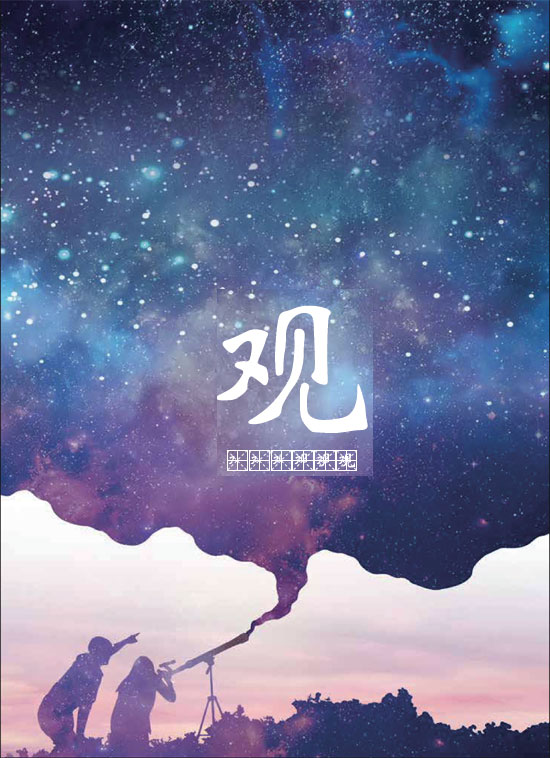
Gazing at the night sky, wondering how we are related to the vast expanse above, has been a hobby of humans since primitive times.
The ancient Chinese viewed the night sky as a reflection of the Earth. It was divided into different sections, each representing a Chinese state or prefecture. An astronomical phenomenon in a particular section of the sky was regarded as a blessing or misfortune in the corresponding area on land. The brightest stars were deemed representations of prominent living figures.
The most important was the "Purple" or North Star. Because all the other constellations seemed to revolve around it, the Purple Star was considered the emperor's own. Such a notion is behind many of the supernatural plots in the classic novel Romance of the Three Kingdoms, in which strategists view the sky at night to predict military actions, or determine the fate of emperors and generals.
The greatest strategist of all, Zhuge Liang, even predicted his own death based on a faded star, making stargazing, or 观星(guānxīng), a life-or-death hobby. Even today, a branch of fortunetelling called "purple star astrology" is still going strong, especially in Taiwan.
Monitoring the night sky was not just for fortunetelling, but an important matter of state as well. Only careful observations of daily movements of the sun, moon and other planets could help the ancient Chinese adjust the calendar and carry out agricultural activities accordingly. Therefore, there's nothing supernatural about 观 (guān), which means to "look, see, watch or observe". The earliest form of the character appeared in oracle bones and later bronze script, resembling a bird (some say an owl) with a pair of huge eyes.
To emphasize the meaning, a radical 見(jiàn, "see") was added on the right, resulting in its traditional form. When simplified, it becomes 观. Historically, observing the night sky was called 观星 (guānxīng) or 观象(guānxiàng). Imperial astronomers worked from an observatory, or 观象台 (guānxiàng tái). In Beijing's Dongcheng district, the royal observatory for the Ming and Qing dynasties is now a museum. Monitoring the motion of stars and planets is called 观测(guāncè, observe and survey, measure), which can also apply to wind, rain and general meteorology.
More generally, 观察 (guānchá) means "observe." Words with 观 are often related to visuals. For instance, to visit a place is 参观(cānguān), "audience" is 观众 (guānzhòng), a sight or landscape is 景观 (jǐngguān), and "to go sightseeing" is 观光 (guānguāng). And there's a special idiom for the type of sightseeing done by some tour groups: 走马观花(zǒu mǎ guān huā), which literally means "looking at flowers while riding on horseback" - to gain a superficial understanding through cursory observation.
On your tour, if you spy a beautiful view, you can describe it as 美观 (měiguān); when the sight is particularly magnificent, use 壮观 (zhuàngguān); when it's a view that's so improbable as to be out of this world, call it a奇观 (qí guān).
Besides "observe," 观 can also be a different kind of watching - "to stand by, not participating." If you say you are 观望 (guān wàng), it means you haven't taken any action yet, but are following the development of a situation.
The character can have a negative connotation, as in 袖手旁观 (xiùshǒu pángguān), meaning "stand by with folded arms, look on unconcerned." But sometimes, as suggested in the ancient military text The Thirty-Six Stratagems, it is wise to delay action. The stratagem 隔岸观火 (géàn guānhuǒ) literally means to "watch the fire burning across the river" - to let all the other parties exhaust themselves fighting, then pick up the pieces. Observation leads to thoughts and ideas. Therefore, 观 could also mean "view," as in 观点 (guāndiǎn, point of view), and 观念 (guān niàn, mentality, concept).
When you don't see eye to eye with someone, you can jokingly say you two "don't share the same three views," or 三观不合 (sān guān bùhé). The "three views" refers to views on the world, life and values (世界观 shì jièguān, 人生观 rén shēng guān, 价值观 jiàzhíguān), notions popularized in China by materialist philosophy. The three views are often invoked when discussing a person's character. If someone says money is the most important thing in life and you disagree, you might say that he or she has a "skewed three views" or "三观不正" (sān guān bùzhèng), though most of the time, the phrase is used in a joking manner when arguing among friends.
When it comes to the viewpoints of oneself and others, 主观 (zhǔ guān, self 's point of view) is subjective, while objectivity is 客观 (kèguān, guest's point view). Along the same lines, optimism is 乐观 (lè guān, happy views), and pessimism is 悲观 (bēi guān, sad views).
Although observation has increased our understanding about the universe today, we are still quite ignorant because our view is limited, as in the idiom 坐井观天 (zuò jǐng guān tiān) - "observing the sky from the bottom of a well." Hopefully, the FAST telescope in Guizhou will broaden our view. Who knows? Maybe its next discovery could change our entire 世界观. From picturing the huge eyes of an owl to understanding the world, 观 is a word for those who are perpetually curious.
Courtesy of The World of Chinese; www.theworldofchinese.com.cn
The World of Chinese
(China Daily European Weekly 01/12/2018 page23)