

Bookshop's history is a page turner
From humble beginnings, London store has developed a key role in promoting China and its literature
On a bright November day, an elegant English lady walked into a cozy bookshop in the heart of London's Chinatown. She picked up a stack of New Year cards and calendars decorated with elaborate Chinese paper cutting patterns and Chinese ink paintings, and warmly greeted the shop assistant.
The lady was 91-year-old Pamela Youde, widow of the late Sir Edward Youde, who served as the governor of Hong Kong between 1982 and 1986. For several decades, Youde has been a loyal customer of Guanghwa Bookshop.
Every winter, she buys New Year cards from Guanghwa for her friends and family, and Chinese calendars for each of her four grandchildren, "to help them learn Mandarin", she says.
|
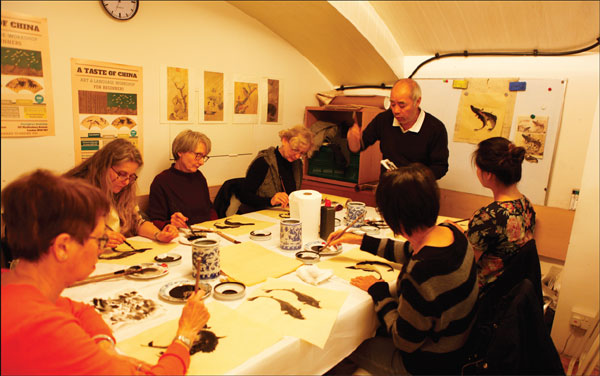
A class on Chinese ink painting is held inside Guanghwa Bookshop. Photos by Cecily Liu / China Daily |
Recalling her fondness for Guanghwa over the decades, she says the Chinese bookshop is a comforting presence for her in London.
"When I first started visiting Guanghwa many years ago, London had very little Chinese, and Guanghwa is probably one of the few places I can visit to find Chinese writing," says Youde, who learned Mandarin at London's School of Oriental and African Studies.
It is loyal customers like her who have encouraged Guanghwa's founder, Deng Jiaxiang, to continue operating the bookshop, even in its toughest times, since its establishment in 1971.

Deng, a Chinese migrant and former chef in London's Chinatown, established Guanghwa out of a love for Chinese books and a patriotic desire to share his culture with a Western audience. He started selling Chinese books as early as 1967, in London's Hyde Park at weekends, and sometimes when business was good he would sell up to 2,000 over a weekend.
In 1971, with help from other Chinese migrants, Deng secured a £2,000 ($2,684; 2,267 euros) bank loan and opened Guanghwa Bookshop, which remains the only Chinese bookshop in London even today.
Thanks to Guanghwa's help in importing books from China, the British Library was able to continue acquiring Chinese books for its collections after a 20-year gap in the 1950s and '60s, when it had no other means of securing them, according to Frances Wood, former curator of Chinese collections.
Over the years, Guanghwa also helped the libraries at British universities such as Oxford and Cambridge to secure Chinese books, so that scholars can continue to conduct research into Chinese language, literature and culture.
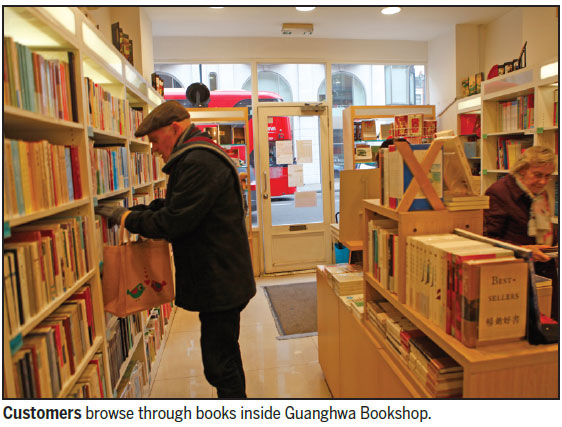
Today's Guanghwa has had a facelift. Its historical and scholarly atmosphere has been replaced by a feeling of liveliness, modernity and diversity. Across its two floors, shelves are stacked with a vast range of books, from Chinese cooking to Mandarin learning, from contemporary teenage fiction to classic and ancient texts.
The shop window shows a trendy display of Chinese cultural objects, including porcelain cups, woodcarved decorations and many soft toys representing dogs - as 2018 will be the Year of the Dog, according to the Chinese zodiac. Downstairs, a teacher leads a Chinese ink painting class, attentively showing his British students the intricacies of Chinese painting, done with big brushes on thin pieces of paper.
What really transformed Guanghwa from a mere bookshop into a fashionable social gathering spot for Chinese literature and cultural lovers was an event in 2007.
That year Deng was approaching retirement age and could no longer handle the physical and financial challenge of operating the shop, so he invited the Chinese State-owned company China International Book Trading Corp to take over the business.
"We were already great friends and partners," says Ru Jing, managing director of Cypress Books, the UK subsidiary of the corporation, established in London in 1984.
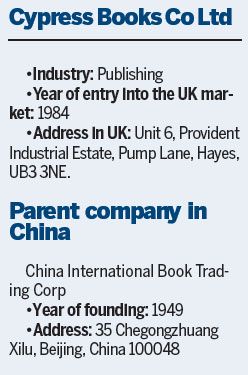
"Over the years, we were the company helping Mr Deng to import books from China. Our collaboration led to incredible trust and friendship, so when Mr Deng started to look for someone who could give Guanghwa a legacy, he thought of us immediately."
Guanghwa was sold to CIBTC for a symbolic £1. Deng's only wish was that the shop's name should remain Guanghwa forever, and Cypress Books gladly agreed.
As for Cypress Books, it also had a long and colorful history in Britain's publishing history. CIBTC was established by the Chinese government in 1949 in Beijing, the same year as the founding of the People's Republic of China.
It was charged with facilitating China's cultural exchanges with the outside world through books. One by one, CIBTC's overseas subsidiaries were established, especially from the 1980s onward when China implemented its reform and opening-up policy, which stirred a keen interest in China in many overseas book markets.
CIBITC's London expansion started in 1984 with a small office near Kings Cross Station, called Cypress Books, staffed with two employees. "It was a small space where our colleagues lived and worked. They worked day and night to select the best books from China to sell to UK publishers, and find suitable UK books to take back to the Chinese audience," says Ru.
Gradually, Cypress Books grew its collection and established a warehouse in West London's Park Royal, where it stores the books it trades.
According to Ru's estimates, Cypress Books has within its collection about 20,000 Chinese titles that it regularly sells in the UK. It mainly sells to UK-based publishers, who then take care of the translation, sales and marketing. More recently, it has also begun to sell a growing number of Chinese language learning books to British schools and universities that teach Chinese.
"In recent years, British readers' interest in Chinese content books has been absolutely phenomenal. Strong growth in China's domestic market has also attracted keen interest from overseas publishing houses to strike collaboration deals," Ru says.
Revenue generated by China's publishing industry has grown by more than $100 billion since 2011. In 2016, China's book retail market grew to $10.1 billion. From 2012 to 2016, Chinese publishers sold the copyrights to more than 50,000 books to overseas publishers.
In 2012, China was made the country of focus at the London Book Fair. As guest of honor, China organized 130 events, from book launches to symposiums. A delegation of about 300 Chinese writers and publishers traveled to London to give talks and exchange views with their Western counterparts.
Another key milestone that boosted international recognition for Chinese literature was the novelist Mo Yan's winning of the Nobel Prize for Literature, also in 2012. Translations of Mo's books are now widely read by an international audience. They also take pride of place on the shelves of Guanghwa, which continually updates its collection to reflect the latest reader preferences.
A close examination of Guanghwa's book selection shows Ru and her team truly understand how a British audience ticks, as many of its China-focused books are actually written in London by British authors. One example is the British Chinese writer Guo Xiaolu's most recent publication Once Upon a Time in the East: A Story of Growing Up, which details her journey migrating from China to the UK. The book was shortlisted for the 2017 Costa Book Awards Biography Award.
Another example is Great Books of China: From Ancient Times to the Present, by Frances Wood of the British Library. The book, which invites readers to discover some of the major achievements of Chinese culture and civilization, has been selling well in Britain since its publication earlier this year.
Despite the growing popularity of China-related books and the tremendous efforts of Cypress Books to modernize and digitize Guanghwa Bookshop's operation, Ru admits that Guanghwa as a stand alone bookshop is still facing a loss, because profits from selling print books are slim while rents in central London are high.
"But we will never close the bookshop, because we know that it is a place where our loyal customers, like Lady Youde, can call home," says Ru.
Instead, Cypress Books will strategically position Guanghwa Bookshop as a retail ambassador for Chinese publications, so that brand publicity can lead to increased revenue from its book trading business, Ru says.
cecily.liu@mail.chinadailyuk.com
(China Daily European Weekly 12/08/2017 page30)