Chinese marine product exports are on a roll
Updated: 2011-05-06 10:52
By Yan Yiqi (China Daily European Weekly)


 Twitter
 Facebook
 Myspace
 Yahoo!
 Linkedin
 Mixx
Mixx
 |
|
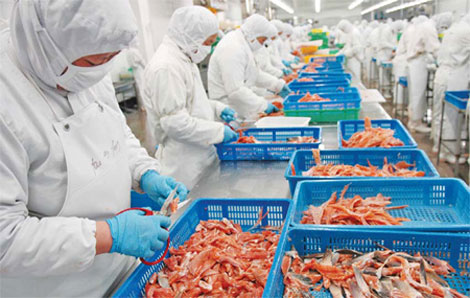
Factories in Shandong province, such as this one in Rizhao, are benefiting from the recent rise of aquatic products exports. Chen Weifeng / for China Daily |
Though the ongoing nuclear crisis in Japan has opened up windows of opportunity for Chinese marine product exporters, it may also pose considerable challenges in the long run, experts say.
Exports of marine products from Ningbo, a coastal city in East China's Zhejiang province, rose 96.2 percent year on year to $87.1 million (58.7 million euros) in March, according to customs data.
The marine bounty has not just been confined to Ningbo. East China's Shandong and Fujian provinces are also reaping the benefits with an increase in shipments to the European Union.
During the first three months of this year, Shandong exported 64,000 tons of aquatic products to the EU, a 28 percent year-on-year increase. While Fujian clocked a 62.26 percent year-on-year increase in marine products exports to the EU in the same period.
Though it is still early, trade circles are of the view that Japan's nuclear crisis has helped buoy the spirits of Chinese marine product exporters.
Export value of marine products from Zhejiang province during the second half of March rose to $150 million, and accounted for nearly 37 percent of the total export value during the first quarter.
"Food safety concerns increased after radioactive substances were detected in Japanese marine products after the earthquake in March this year. Buyers had to source products from other regions like China to satisfy demand," says Liu Bin, a researcher at the Chinese Academy of Oceanic Development.
Brown alga, or undaria pinnitafida, is now mainly imported from China as the earthquake devastated the main production base in Fukushima, Japan. According to customs data, undaria pinnatifida exports from China rose nearly 30 percent to $5.5 million in March.
Shipments of other marine products such as sea cucumbers, prawns and fresh tuna have risen by 458.6 percent (to $589,336), 62 percent ($76.1 million) and 116.6 percent ($14.4 million) respectively during the period.
"China is fast becoming the backup producer for marine products globally," says Liu.
Although China is close to Japan, its marine products remain largely unaffected by the radiation troubles in Japan, says Liu Guimei, deputy director of the marine environment office under the National Marine Environmental Forecasting Center of the State Oceanic Administration.
"We expect the radioactive sea water to gradually flow into the north Pacific, though some radioactive particles could be blown by air and may fall in the sea (near China) in small quantities," she says.
"But there is nothing to fear as the ecosystem of the ocean itself will resolve the issue. When it comes, the radioactive particles might have already been diluted to nothing," says Cui He, executive vice-president of the China Aquatic Products Processing and Marketing Association.
The surging export volumes, however, has come as a whiff of fresh air to Chinese exporters who were struggling to make a mark on the global scene.
"Japan was one of the main marine products exporters. With the market losing confidence in Japanese products after the nuclear crisis, it is the right time for Chinese producers to fill in the breech," says an official from the Fujian Entry-Exit Inspection and Quarantine Bureau on condition of anonymity.
The Fujian bureau has already started educating companies on the nuances of global deals and also help registering them for foreign trade.
Despite making the right waves, Cui perceive many obstacles for Chinese companies in the long run.
"It is still unclear as to what kind of market share can the Chinese companies expect and how much of it will come from Japanese companies. There is also no guarantee that the trend will not be reversed later," says Cui.
Cui says though China has been one of the largest aquatic products exporters to the EU and the US for a long time, Japan is still a formidable rival.
"It is too early to say that Chinese producers will replace Japanese counterparts in the long run. Once Japan has recovered from the nuclear crisis, many buyers may go back to Japanese companies," he says.
Cui feels that Chinese companies should exercise caution and not be in a hurry to expand their global footprint. "The larger the expansion is, the more losses will it be after Japanese companies return to the market."
Chinese companies could also face quality hurdles in European and other markets.
According to Cui, most of China's marine products exports are wild, and not farmed. It is easier for the wild products to conform to EU's strict import rules rather than farmed ones.
"Some of the farmed aquatic products may not pass muster in Europe as there are doubts that the growers have used additional objects during the breeding process," Cui says.
Changing consumption trends and a burgeoning population are putting a severe strain on ocean resources and triggering a shift to farmed aquatic products, he says. "Chinese producers need to make considerable investments in research and development of farming technologies if they want to maintain their current top slot."
E-paper

War of the roses
European Chinese rose growers are beating their Chinese rivals at their own game
High-tech park gets big boost
At the source
Merchant of Venice
European Edition

Specials

High-tech park gets big boost
Zhongguancun sets sights on being one of the top technology hubs in the world

Learning to close the gap
Thousands of students have benefited from Tibet middle school program set up outside the autonomous region

The Cixi story
Two books about the Empress Dowager cast new light on the iconic ruler.