Nation reports 1st deficit in 7 years
Updated: 2011-04-15 11:24
By Zhong Nan (China Daily European Weekly)


 Twitter
 Facebook
 Myspace
 Yahoo!
 Linkedin
 Mixx
Mixx
 |
|
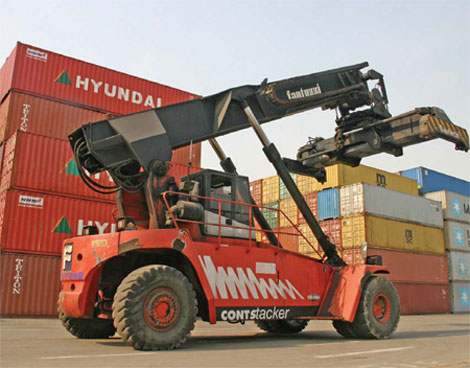
China's trade with the European Union grows by 22 percent year-on-year to $123.7 billion in the first quarter of this year. Provided to China Daily |
But quarterly trade with EU shows surplus
China reported its first quarterly trade deficit in seven years, although bilateral trade with the European Union (EU) registered a surplus.
China had a first-quarter deficit of $1.02 billion (706 million euros), compared with a surplus of $13.9 billion last year, the General Administration of Customs says.
This is the first deficit since 2004 when an $8 billion deficit was reported in the first quarter of that year.
However, China had a $29.48 billion surplus with the EU in the first quarter, with bilateral trade rising 22 percent year-on-year to $123.7 billion.
Exports to the EU grew by 17.2 percent from a year earlier to $76.59 billion, while imports surged 30.6 percent to $47.11 billion.
Economists say the growth showed that Sino-EU trade has gathered pace after seasonal factor faded.
"Trade is back on track, as many European countries' economies are gradually recovering from the recession," says Zhao Ying, a professor at the Institute of Industrial Economics of the Chinese Academy of Social Sciences.
"Chinese exports to the EU shrank in February due to the Spring Festival holiday, but they bounced in March."
Businesses usually slow down during the Chinese New Year period, which was in February this year.
He says China will send more trade delegations to Europe and the United States to buy more goods, a practice China often uses to narrow trade imbalances with major trading partners.
In March, bilateral trade between China and the EU stood at $47.5 billion, with China enjoying a trade surplus of $9.48 billion.
Exports to the EU grew by 33 percent in March from a year earlier to $28.49 billion, while imports surged 31 percent to $19.01 billion.
Liu Wenge, a professor of international trade at the Central University of Finance and Economics in Beijing, says the economic recovery in the EU has increased the demand for Chinese consumer goods in March and is "a cheerful sign for Chinese manufacturers".
"China's demand for high-end European products will continue to remain strong as the nation is keen to import more from the EU, which would effectively reduce the trade friction between two sides," Liu says.
In March, the Ministry of Commerce, together with seven other ministries and administrations launched guidelines on promoting the imports of mechanical and electronic goods, including those in new energy, energy-saving and high-end equipment manufacturing sectors from developed countries, in the next five years.
In 2010, China's imports grew by 38.7 percent, 7.4 percentage points higher than exports, and China's imports from the EU increased 30.2 percent from a year earlier.
China's first quarter deficit was chiefly attributed to efforts to promote imports and the soaring prices of key imported commodities, says Zhang Yansheng, director of the Institute for International Economics Research under the National Development and Reform Commission.
"Reduced export growth, due to the rising costs of labor, land and oil, along with yuan appreciation and rising interest rates also contributed to the deficit," he says.
Dong Xian'an, chief economist at Peking First Advisory, says there are three reasons behind the deficit.
"Chinese manufacturers hoarding commodities in anticipation of inflation, the Japanese earthquake and political turmoil in some Arab nations helped push up prices," he says.
Dong also cites China's increasing overseas purchases, including high-tech equipment, aircraft, raw materials, soybean and corn toward the end of 2010 as another reason.
Iron ore imports grew by 14.4 percent to 180 million tons in the first three months of this year, while the average price rose by 59.5 percent year-on-year.
Soybean imports dropped by 0.7 percent to 10.96 million tons, but the average price increased by 25.7 percent.
But economists believe the deficit will not last amid efforts to control capital flow and combat inflation.
"The tightening policies will hold back import growth by both volume and value," says senior economist Stephen Green, head of research at Standard Chartered Shanghai.
"The second and third quarters will see trade surpluses. So pressure to appreciate the yuan will remain."
Zhou Shijian, a senior researcher on trade relations at Tsinghua University, says the trade surplus will return, as "exports usually see strong growth during the second half" of the year.
"A full-year surplus of around $100 billion is comfortable for China and its economic growth," he says.
The trade surplus dropped to $196 billion in 2009, down from a record $295 billion in 2008. The figure further shrank to $183.1 billion last year.
E-paper

Han me downs
A classical Chinese zither fills the air with serene sounds as a newly-wed couple walks slowly down the red carpet in a room decorated with luxurious golden veils and shining bronze ware.
Fast growth fuels rise in super rich
Chinese tourists spend more
Reaching out
European Edition
Specials

Share your China stories!
Foreign readers are invited to share your China stories.

No more Mr. Bad Guy
Italian actor plans to smash ‘foreign devil’ myth and become the first white kungfu star made in China.

Art auctions
China accounted for 33% of global fine art sales.