Guizhou to serve as springboard for EU firms
Updated: 2011-04-08 11:07
By Zhong Nan and Yang Jun (China Daily European Weekly)


 Twitter
 Facebook
 Myspace
 Yahoo!
 Linkedin
 Mixx
Mixx
 |
|
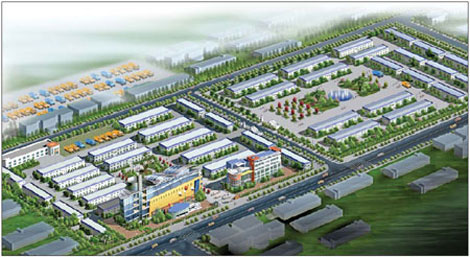
The layout of the European industrial zone, for which construction started on March 25, in Anshun, Southwest China's Guizhou province. Provided to China Daily |
Small businesses show interest in inland China
European businesses will invest 800 million euros to establish an industrial zone in Southwest China's Guizhou province, a sign of foreign investors' growing interest in China's inland areas.
The money will be spent over three years to set up an 8-sq km European industrial zone in Anshun city.
The Guizhou government has also invested 100 million yuan (10.8 million euros) to build supporting facilities such as a hospital, labor training school and highways for the industrial zone.
Eleven European enterprises will undertake factory construction work in May.
"China offers a wealth of business opportunities as the European Union is yet to fully recover from the economic downturn," says Jose Soares, Portugal's ambassador to China.
Soares says that many small- and medium-sized enterprises from the EU are keen to cooperate with new European industrial zone in Anshun.
Zhou Yiping, president of the Overseas Chinese Federation of Portugal, says the Chinese market itself is big and attractive.
He says inland areas such as Guizhou have become all the more attractive to EU investors, thanks to cheap land, favorable policies, cheaper labor and inexpensive raw materials.
For example, the overall industrial land costs are one-fifth of those in big cities such as Shanghai, he says.
Zhou also believes Guizhou is a good springboard to tap nearby markets.
"Thanks to the location, it is very convenient to transport European products from Guizhou to Southeast Asian countries," Zhou says.
Fernando Morais, president of the National Association of Small- and Medium-Sized Enterprises of Portugal, says: "With most of the EU companies moving their businesses abroad for resource integration, China has become an ideal destination to set up factories, innovation centers and branches of transnational companies."
Zeng Haiying, a professor from the economic research center of the Guiyang-based Guizhou University, says more and more foreign investors, including those from the EU, are investing in less developed Chinese regions.
"The trend is obviously there," she says.
"These regions need money to develop; their markets are big and growing; and the cost of doing businesses is much lower. EU investors have the money and are eager to find new markets in China. It is a good mix and match."
But Zeng cautions that lack of skilled workers and managers and poor infrastructure are the major hurdles for foreign businesses.
Between January and February, the number of new EU enterprises in China increased 11 percent year-on-year to 251.
The actual investment from the EU rose 65 percent from a year earlier to 965 million euros, according to the Ministry of Commerce.
The United Kingdom, Germany, France and Luxembourg were the top four EU investors in China during this period with a total investment amount of 745 million euros.
A survey by the European Union Chamber of Commerce in China shows that 78 percent European businesses are optimistic about the growth in their sectors over the next two years.
They have seen the Chinese market recover strongly and anticipate that it will create opportunities for them.
E-paper
Green light
F1 sponsors expect lucrative returns from Shanghai pit stop
Buying into the romance
Born to fly
Light of hope
European Edition

Specials

Share your China stories!
Foreign readers are invited to share your China stories.

No more Mr. Bad Guy
Italian actor plans to smash ‘foreign devil’ myth and become the first white kungfu star made in China.

Art auctions
China accounted for 33% of global fine art sales.