Beer prices to bubble up
Updated: 2011-03-25 10:32
By Hu Haiyan (China Daily European Weekly)


 Twitter
 Facebook
 Myspace
 Yahoo!
 Linkedin
 Mixx
Mixx
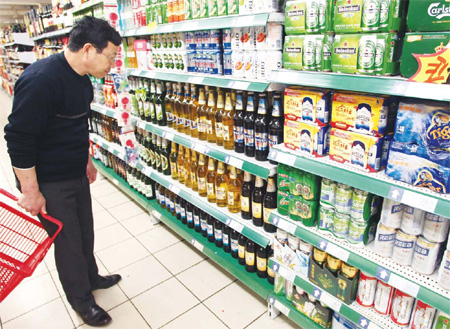 China's per capita consumption of beer is rising but it is still far smaller than the level in the West. Provided to China Daily |
Huang Wei, a food and beverage industry researcher with Citic Securities, says wheat prices - which account for up to 6 percent of the beer production process - have in recent months shot up by 10 to 20 percent, and continue to rise steadily.
The ex-factory price of a 330-milliliter can of Yanjing beer, one of Beijing's most popular brews, has gone up from 1.6 yuan (0.17 euro) to 1.8 yuan, an increase of 12.5 percent.
And Tsingtao Brewery, one of China's largest local beer makers, has increased the prices of some of its products by 10 percent, Huang says. "With the rise in the wheat prices, the competition in the beer market will be fiercer and the process of mergers and acquisitions will be accelerated. Some small and not so competitive companies are likely to lose in this market."
However, Huang says these increases are not expected to affect market share of the various breweries as in the "backdrop of inflation, prices of all products are on the rise".
Jin Zhiguo, president of Tsingtao Brewery Co Ltd, says the company "will streamline the process and reduce the overall costs" in an attempt to keep the price increases to a minimum.
Li Fucheng, president of Yanjing Beer Group Corporation says the increase in grain prices will definitely have some impact on beer prices, but "through some adjustments, such as the product structure, which means producing more mid-class beer or high-end beer, the effects brought by the rising grain costs can be reduced".
Analysts say the rising cost of grains will make the industry more competitive. "In the past, the beer producers competed with each other by way of lower price," Du Futai, secretary-general of the beer committee of the Chinese Food Association, says. "Through many years' development, the Chinese beer market is consolidating quickly and has already nurtured some well-known brands. But it is not possible for the companies to survive just by products with lower price."
Du also says that beer has been underpriced, so in the long term prices will go up, irrespective of the cost of raw materials.
For example, the technology used in producing beer is much more complicated than that of mineral water, but a 330-milliliter can of beer sells for between 2-3 yuan, while mineral water sells for about 1 yuan.
"Compared with other beverages, beer has the lowest profit margin," Du says.
To combat rising raw material prices, Du suggests, beer producers have to be innovative and efficient enough to adjust their products structures, so that they can produce more good beer with fewer raw materials.
Instead of raising prices, beer producers could, for instance, change into smaller packages, hence reducing the content from 660 milliliters to 600 milliliters, and yet sell it at the same price.
Zhou Siran, an analyst with China Investment Consulting Company, says the rising prices of grains would put beer producers under greater pressure, but bring different consequences to different companies.
"For companies which mainly produce products at lower prices, the rising price of grains will bring more pressures," Zhou says. "For larger companies, the influence of rising costs can be overcome by expanding their business expansion or adopting more efficient producing methods."
Zhou says beer companies mainly focus their attention on marketing and channels, and don't attach enough importance to cost control. "In the long term, beer producers should set great store by building an industry chain and investing in more efforts to ensure the stable supply of raw materials."
E-paper

Pearl paradise
Dreams of a 'crazy' man turned out to be a real pearler for city
Literary beacon
Venice of china
Up to the mark
European Edition

Specials

Power of profit
Western companies can learn from management practices of firms in emerging economies

Foreign-friendly skies
About a year ago, 48-year-old Roy Weinberg gave up his job with US Airways, moved to Shanghai and became a captain for China's Spring Airlines.

Plows, tough guys and real men
在这个时代,怎样才"够男人"? On the character "Man"