Next Big Thing —3D TV
Updated: 2011-03-18 10:57
By Meng Jing (China Daily European Weekly)


 Twitter
 Facebook
 Myspace
 Yahoo!
 Linkedin
 Mixx
Mixx
|
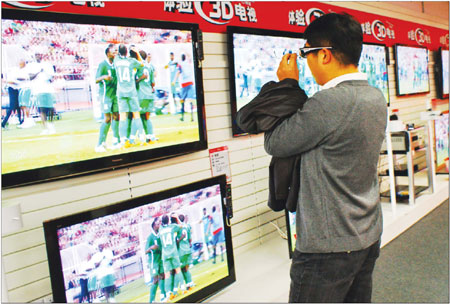 More supermarkets and shopping malls have been, since the second half of last year, earmarking bigger areas to display 3D TV sets. [Jin Wei/for China Daily]
|
Despite high costs and a shortage of content, many bet on 3D boom
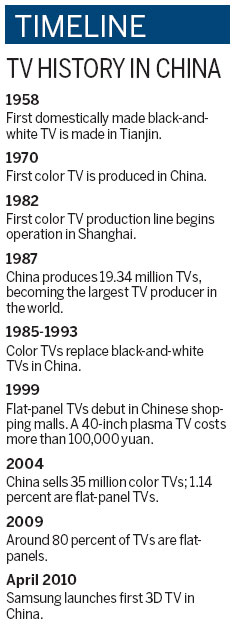
The television industry has experienced two major revolutions ?from black-and-white to color and from box sets to flat screens. Now, the third is beckoning: 3D TV. It's the biggest trend in consumer electronics this year and industry talking heads are hyping up the technology as a surefire solution to bring the enthusiasm over 3D cinema into your living room.
Many brands, such as Sony, Samsung and Toshiba, are rolling out products that boast sharp 3D viewing. And although 3D TVs account for a small share of the television market, industry insiders in China say the buying power of more than 1.3 billion people will soon boost sales of 3D TV units and even help the country become a major player in the international 3D TV industry.
|
|
Not so fast. Before consumers reach for their wallets and buy a top-of-the-line 3D TV, there are many glaring issues with the technology.
First, the high costs. Cai Ling, researcher with the Shenzhen-based CIC Industry Research Center, says that the 3D TV technology is still in its early stages.
The industry, in China and abroad, has not established a technology standard for companies to follow, which means that the price for a Samsung 3D TV could be very different than the price of a Changhong 3D TV, which is domestically produced.
In Beijing, a domestically made 3D TV costs around 4,000 yuan (437 euros) while a top-end Toshiba 3D TV costs around 50,000 yuan.
"Very few people want to spend a lot of money on a 3D TV and most of them are waiting for better 3D TVs to be developed," Cai says.
Yan Fei, former vice-president at TCL Multimedia who oversaw the company's 3D TV department, also says the prices for 3D TV units are still too high for families.
Yan estimates that prices in China will drop dramatically to approximately 20 percent higher than most TVs by the end of this year.
"Price will not be a problem soon," Yan says, "but the lack of (3D) content is still unsolved for now."
That brings up the second issue: Content, or the lack thereof.
According to experts spoke to China Daily, there is as of yet no industry-wide push in China to produce 3D content, although a dozen TV stations said last year that they have plans to launch 3D channels.
But broadcasters such as China Central Television (CCTV) have not begun to invest in producing 3D TV shows. Japan's BS11 was one of the first 3D TV channels in the world when it launched in 2007 but the channel only has a one-hour 3D TV program on a daily basis.
"No one wants to buy a 3D TV only to watch one hour a day," Yan says.
In the United States, 3net, a joint venture TV network by Sony, Discovery Communications and IMAX Corp, has launched its 3D network through DIRECTV for 24 hours, 7 days a week.
But experts agree that the lack of 3D TV programs is the key reason keeping the industry from growing. With the lack of content, they say, sales of 3D TV units will stagnate. And if there aren't many 3D TV users, investors won't find the technology attractive.
"How to make profit by producing 3D TV programs when you face such a small group of audience is the main question in front of us," says Gao Rong, general manager of Shanghai-based Foreign Advertising, a major producer of 3D TV programs in China. Foreign Advertising recently produced a documentary in 3D about the Shanghai Expo. It also has a weekly travelogue show called 3D Kan Tian Xia for Shanghai's ICS TV station. Each episode lasts 12 minutes.
Last, the goggles. Each manufacturer of 3D TVs produces its own goggles and none are compatible with another.
Nonetheless, the 3D TV industry is growing, mostly because of the boom in the 3D movie industry and because of the popularity of James Cameron's epic sci-fi movie, Avatar.
Most Chinese knew little about 3D movies until the launch of Avatar in January 2010. It was a whopping success in China, bagging 1.32 billion yuan in box office sales.
The number of new cinemas and upgraded movie screens has since exploded across the country. In 2010, there were 2,100 digital movie screens, capable of showing 3D movies, accounting for 65 percent of all movie screens in China, according to EntGroup, an entertainment research company based in Beijing. In 2007, there were 700 digital movie screens.
E-paper

Pearl paradise
Dreams of a 'crazy' man turned out to be a real pearler for city
Literary beacon
Venice of china
Up to the mark
European Edition

Specials

Power of profit
Western companies can learn from management practices of firms in emerging economies

Foreign-friendly skies
About a year ago, 48-year-old Roy Weinberg gave up his job with US Airways, moved to Shanghai and became a captain for China's Spring Airlines.

Plows, tough guys and real men
在这个时代,怎样才"够男人"? On the character "Man"