Fresh spin
Updated: 2011-03-04 10:47
By Xu Junqian (China Daily European Weekly)


 Twitter
 Facebook
 Myspace
 Yahoo!
 Linkedin
 Mixx
Mixx
 |
|
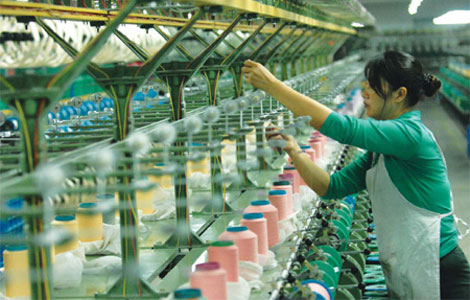
A woman works at the Silk Road factory in Huzhou, Zhejiang province. The city in China's affluent Yangtze River Delta is trying to revive its ancient silk industry. Provided to China Daily |
Ancient Chinese silk center sets its sights on the future
The ancient silk town of Huzhou in East China's Zhejiang province, from which exquisite fabrics once clothed Chinese emperors and British queens, is now one of the key industrial cities hosting thousands of factories that churn out a wide range of consumer goods from stuffed toys to flat-panel TV sets. Amid rapid industrialization, the art of silk making has largely been lost.
While most people in Huzhou have accepted the town's transformation, local entrepreneur Ling Lanfang has spent most of his time and money trying to revive the trade.
The 58-year-old former silk-spinning worker bought a bankrupt silk workshop in 1998 with his entire savings of 28,500 yuan (3,141 euros).
Since then, he has turned it into a money-making enterprise, which he named Silk Road, through a variety of businesses including building materials and pharmaceuticals.
In his office in an old-fashioned four-floor building at the city center, Ling says that his primary interest remains silk.
 |
"I have been sinking a big portion of the profits from my other businesses into silk making with the hope of reviving the lost glory of my home town," Ling says.
Indeed, silk put Huzhou on the international map when samples of Jili silk, woven by the town's best craftsmen, won the gold medal at the first World Exposition in London in 1851.
"Now I just want to bring back the lost craftsmanship and re-establish a thriving silk industry that was our pride for many centuries," Ling says. "It's not all about money."
His efforts are beginning to produce results. Last year, representatives from some of the world's top fashion houses such as Chanel and Hermes placed test orders for his silk products.
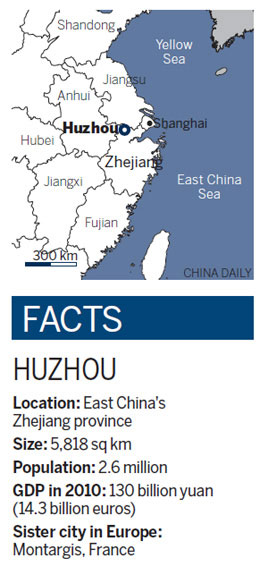
Like many upcoming cities in China's affluent Yangtze River Delta, Huzhou, covering an area of 5,818 square kilometers, boasts a soaring property price that hardly matches its residents' income and a growing skyline of high-rises that follow the metropolis lying 130 km northeast of it, Shanghai.
But the 2,300-year-old city also boasts a long tradition of sericulture that has fueled the pride of many of its residents like Ling, one generation after another, and made them believe it was their ancestors that have built up today's Shanghai, the financial hub, to some degree.
According to Lu Shihu, a local historian, people in Huzhou began planting mulberry trees and raising silkworms in the Yuan Dynasty (1271-1368).
Its geographical position by the Taihu Lake and warm climate made it an ideal base for sericulture, producing silk that is distinguished by a milky-white color.
The fabric is resilient and translucent, and was favored by the imperial court in Beijing.
Recent archeological findings, a few pieces of fragment silks dating from 4,700 years ago discovered in Huzhou, also proved that it is the earliest place to have carried out sericulture.
It was not until the 1840s when foreign nations were allowed to trade in Shanghai that the industry started to prosper.
 |
|
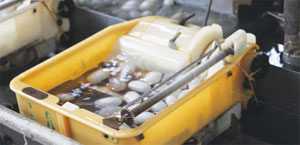
Silkworm cocoons are processed in the factory. Provided to China Daily |
Huzhou silk established itself as being synonymous with the best silk in the world.
Large quantities of silk were shipped from harbors in Shanghai to European countries, where silk was still a very precious and rare material for royals.
Wealth quickly accumulated among several Huzhou silk tycoons, who had taken up more than half of the market then.
Nobody keeps count of the combined volumes of silk exported in those large wooden containers. But in the following years, as the silkworms kept by almost every family in Huzhou spun cocoons and then silk, villas, voluptuous ball rooms and a 24-floor-tall skyscraper, the tallest then in Asia, were built in Shanghai by Huzhou businessmen.
It is estimated that the collective wealth of these silk tycoons reached more than80 million liang of silver (2.5 million in kg, equals 16 billion yuan), exceeding the annual revenue of the central Qing government (1644-1911) then.
Even in the secluded days of China in the 1960s, the silk industry in Huzhou was at its zenith. Every one out of five people in the city was working in the industry, and every year the industry created a total amount of foreign currency for the country that could build another six Huzhou cities, says Zhang Jianxin, a retired director of the No 2 Zhejiang Silk Plant, one of the biggest textile factories in China then.
But shipping silk in bulk abroad no longer seems to be such a profitable business in recent years.
Even though 10 percent of the silk in China, the world's largest silk producer, still come from Huzhou today, Ling, the President of the Silk Road Group, the biggest silk manufacturer in the city which also ranks third in the country with a market share of 3 percent, has found himself profitless.
In 2010, the group grossed more than 2 billion yuan. Yet, of its 60-million-yuan profit and tax, only 33 percent come from the silk business, which employs up to 90 percent of its 3,000 employees. The majority of the profit came from subsidiary businesses like medicines and building materials.
"When I invested all of my savings, 28,500 yuan, to buy out the silk factory that laid me off 20 years ago, I never expected it to be so difficult," says Ling, who started his silk career right after graduating from junior high school, at the age of 17.
 |
Customs statistics show that China's silk exports exceeded $3 billion (2.2 billion euros) in 2010, and Zhejiang remains the largest producer, accounting for about one-fifth of the total exports.
Silk trade with Italy, China's third-largest silk export destination after the United States and India, enjoyed a 37.7 percent increase from 2009, the highest in terms of growth rate among all countries, according to Customs.
But now with an increase of 15 percent of revenue from silk every year, Ling seems more than optimistic about the future of his silk business.
"Hermes sells its sq-m-sized silk scarf for 2,000 yuan a piece. The price of raw silk exported from here is 200 yuan a kilogram, which has more than tripled in the past few years," Ling says.
"If we keep being the middleman squeezed between the cocoon farmers and the foreign companies, we are sure to lose. But if we sell made-up silk articles as our ancestors sold raw silk century ago, it's a whole new story," he says.
"It's not like making computers or building planes, we are known for being good at it," he says.
Ling says he has been investing 50 to 60 million yuan every year since 2008 to upgrade his machines and buy out local factories to complement his business scope.
"This year, I want to set my foot abroad, seeking more opportunities with experienced design workshops in Italy or France, the center of fashion world, and we would like to talk to anyone interested," Ling says.
"Now we have the best material, the most skilled hands, and the most high-end machines," he says.
"All we need is a brilliant stroke to make our milky-white silk more colorful and we are a step closer to being the 'Louis Vuitton' of the silk world."
E-paper
Sindberg leaves lasting legacy
China commemorates Danish hero's courage during Nanjing Massacres.
Crystal Clear
No more tears
Road to the Oscars
European Edition
Specials
NPC & CPPCC sessions
Lawmakers and political advisers gather in Beijing to discuss major issues.

Sentimental journey
Prince William and Kate Middleton returned to the place where they met and fell in love.

Rent your own island
Zhejiang Province charts plans to lease coastal islands for private investments