feeling at home
Updated: 2011-02-25 11:27
By Yang Yang (China Daily European Weekly)


 Twitter
 Facebook
 Myspace
 Yahoo!
 Linkedin
 Mixx
MixxBeijing’s furniture street taps into growing domestic tastes
At Lily's Antique store, the largest furniture shop in Beijing's Gaobeidian classical furniture street, Beijinger Grace Wang negotiates with a saleswoman to return an antique cabinet worth 5,000 yuan (555 euros). Wang, a 35-year-old finance employee at a Chinese Fortune 500 company based in the capital, wants to order a 3,000-yuan Indian-style mirror instead.
|
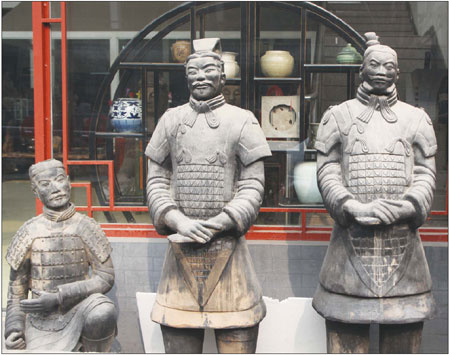 Beijing's Gaobeidian classical furniture street has more than 400 shops, with sales of 27.7 million euros in 2010. Feng Yongbin / China Daily |
Wang has just moved into her new 93-square-meter apartment in Beijing. Decorating the two rooms by herself, she came to the street to select old furnishings to match a traditional Chinese style mixed with exotic Southern Asian ornaments.
"I still like old, classical Chinese furniture because it is not simply for practical use but also offers quaint artistic works worth collecting," she says.
"Besides, compared with new furniture, old pieces made of wood are more environmentally friendly because they do not release toxic gases and people will not discard them casually."
Wang is just one of many frequent visitors to the 1,800-meter long classical furniture street, which attracts tens of thousands of buyers and tourists from home and abroad each year as the largest Chinese replica and antique furniture market in the Chinese capital.
"The sales of the furniture shops in this street reached 250 million yuan (27.7 million euros) in 2010 alone," says Liu Xin, director at the publicity office of Gaobeidian village where the street is located.
The street was not formed by accident.
Gaobeidian village, only 8 kilometers from Tian'anmen Square, has a history dating back more than 1,000 years. Situated next to Tonghui River, Gaobeidian was a wharf for inland waterway transportation and a hub for food shipments from all over China that was destined for the emperor's table.
In 2001, when people started to research the history of the village, they found a number of time-honored furniture brands, Liu says.
At the beginning of this century, urbanization prompted villagers to start an industry based on the furniture.
There were already a dozen furniture shops exporting antique items. After researching the sector for one year, the village held an exhibition of antique furniture in October 2003.
Since then, the street has been gradually expanding to more than 400 shops, selling mainly Ming-Qing dynasty antique furniture, imitation antique furniture, as well as imported furnishings and ornaments.
In 2007, the street already had more than 100 overseas customers, Art Market magazine reports.
"In earlier years, sales from a number of large exporters accounted for 80 to 90 percent of total sales for the area," the report says.
But since the global financial crisis in 2008, domestic spending on antique furniture has surpassed overseas sales instead.
"Export sales in our shop decreased from 90 percent of total sales at the beginning, when we mainly carried out exports, down to two-thirds five years ago, and since the financial crisis, to less than half," says Han Ning, sales manager at Lily's Antique for five years.
"In the past two years, domestic buyers have been willing to spend more money on antique furniture - from several hundred to several thousand yuan five years ago, to tens of thousands or even more than hundreds of thousands for purchases now."
Gushengtang Classical Furniture, another major player in Gaobeidian, has also seen a decline in exports.
"We have a lot of business in Europe, especially in France. In earlier years, exports accounted for half of the entire sales, but since the financial crisis the domestic business is much better. Sales at our shop are growing by 20 to 30 percent each year," says Sun Zhilei, manager of Gushengtang.
Domestic demand for antique furniture started growing only from 2004, although 12 years ago a number of big antique shops including Lily's Antique and Gushengtang entered the area with exports as their main business, Liu Xin says.
"Since 2004, more Chinese people have gradually realized the value of antique furniture," Liu says.
"The price of a piece of furniture can go up to several hundred thousand yuan. The third floor of our shop is a small museum, keeping the most precious collection," Lily Antique's Han Ning says
"The age of people coming to us range from 30 to 50, and now an increasing number of young people with higher incomes frequent this place."
Chinese people's traditional beliefs about luck are injected into antique furniture, Liu says, and "many foreigners love Chinese antique furniture for the same reasons".
"When Mrs Rogge (the wife of current International Olympic Committee president Jacques Rogge) visited Gaobeidian in October 2006, she said antique furniture is valuable because it is environmentally friendly, unique and carries great meanings, like bats symbolizing blessings," Liu says.
"All furniture sold in this street is made purely of wood. Even if the items are broken or get old, our craftsmen can recondition them. In this way, people will throw away less of their furniture and therefore, antique furniture or reproduction furniture is greener," Liu Xin says.
However, stocks for real antique furniture are limited and the production of imitation antique furniture, especially those made of precious mahogany, can be environmentally damaging. Prices of raw materials are also rising.
"We are trying to update the industry. We encourage shops to expand their products from making and selling furniture and ornaments to providing services in interior design and decoration," Liu says.
"For example, some shops can help customers decide how to organize the orders of furniture and which wood they should choose based on the knowledge of feng shui and their horosccopes," Liu says.
Shops on the street are now selling antique furniture purchased from Gansu and Shanxi provinces, imitation antique pieces from Hebei province, and representative furnishings from the Tibet autonomous region and Northeast China, as well as ornaments and furniture imported from Europe and Southeast Asia, or new works by designers.
Confronted with the competition from Panjiayuan and Lujiaying, two other famous antique furniture markets in Beijing, Gaobeidian players are emphasizing their own decorative or production styles, Liu says.
"Some big shops invited specialists to design their decorations based on their products," Liu says.
"For example, Lily's Antique makes full use of light to design its more than 6,000-sq-m display halls to create a green and comfortable atmosphere," Liu says.
"Shop owners keep their most precious collections in a separate place, like a small museum."
E-paper

Pearl paradise
Dreams of a 'crazy' man turned out to be a real pearler for city
Literary beacon
Venice of china
Up to the mark
European Edition

Specials

Power of profit
Western companies can learn from management practices of firms in emerging economies

Foreign-friendly skies
About a year ago, 48-year-old Roy Weinberg gave up his job with US Airways, moved to Shanghai and became a captain for China's Spring Airlines.

Plows, tough guys and real men
在这个时代,怎样才"够男人"? On the character "Man"