Battling to stay afloat
Updated: 2011-02-25 11:01
By Zhong Nan (China Daily European Weekly)


 Twitter
 Facebook
 Myspace
 Yahoo!
 Linkedin
 Mixx
Mixx
|
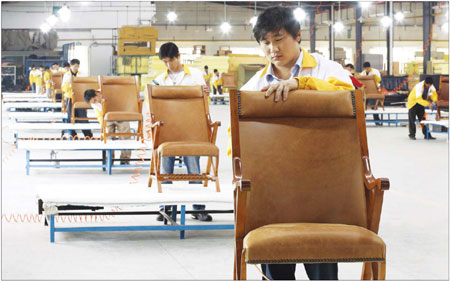
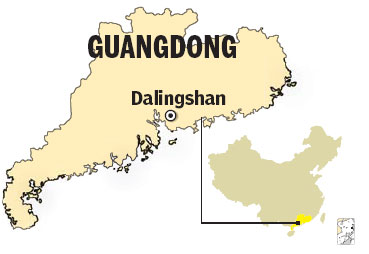
Workers assemble chairs at a Xinxiang Group factory in Dalingshan, Guangdong province. The furniture maker has seen its exports drop over the past few years. Provided to China Daily |
Chinese furniture hub retools to tackle EU quality standards
Dalingshan looks every bit like a typical manufacturing town in China, bustling with workers dressed in blue in the country's largest furniture exporting region. And for years, the town has functioned like a typical Chinese manufacturing town. Two years ago, factories in the area churned out furniture for overseas markets, with sales revenue from the European Union reaching $540 million (396 million euros).
But gone are the days of companies in Dalingshan focusing on exports and international markets. Factory owners and operation managers are retooling and, in their new business strategies, are shifting more toward the domestic market. The reason? Industry experts, factory owners and managers are pointing their fingers at new or recent laws in product quality standards adopted by the EU as the main culprits.
"European technical standards have hindered and even hurt Chinese furniture products entering the EU market," says Yin Jiang'an, general manager of Jinmaoda Furniture, one of the largest factories based in Dalingshan. "It would cost more to fulfill those ecological details, this is the reason why factories in Dalingshan are now keen on developing a domestic strategy."
Jinmaoda Furniture specializes in making wooden home furniture and employs 1,500 workers. Like other furniture makers in the town of 400,000 people, it saw exports drop to $486 million last year, according to figures from the Dongguan Furniture Industrial Association. The association also blames new policies adopted by the EU for the decline, though it also admits that the global recession has had a major influence on the town's economy.
Yin says the new laws have quickly affected Dalingshan. He says Dalingshan-made wooden furniture products could be sent back from the EU if they were not up to EU quality standards, particularly on ecological and health aspects.
Furniture with dimethyl fumarate alone could trigger allergic reactions. It can also cause nausea, difficulty in breathing, and eye, nose, and throat irritation.
In 2009, the EU Commission required member states to ensure that products containing the biocide dimethyl fumarate are not placed or made available on the EU market. Manufacturing products containing dimethyl fumarate from outside the EU are forbidden to enter the EU member states.
 |
The EU also adopted the Forest Stewardship Council certification and the Illegal Timber Regulation as standards to judge the quality of furniture exported from China. Chinese industry experts say these are strict acts against Chinese furniture exporters to the EU market. Part of the impetus for the law was the urging by EU members Germany, Italy, Poland and the United Kingdom to the European Commission for strengthening the enforcement of export laws.
The EU standards stipulate that foreign furniture sold in the EU must meet their new criterion on environmental, ecological and formaldehyde emission standards. Many Chinese furniture makers believe the new standards are complicated and costly to reach.
"Only a few furniture makers based in Guangdong and Zhejiang provinces are able to deliver products to meet the changes of these acts at present," says Ma Zhen from the China National Light Industry Information Center.
He says that exports of wood furniture from China to the EU will be greatly reduced this year because of the new standards.
The EU is considering promulgating a new labeling law during the first half of 2011 to ensure that people know the source of origin of imported goods such as wooden furniture, shoes and leather products sold in 27 member states, according to the website of the Dalingshan Furniture Association.
As a major wooden furniture exporter to the EU, this law will produce difficulties in exporting Chinese wooden furniture and solid wood flooring to the EU market.
"All these standards were designed to enforce stricter environmental performance and quality requirements on Chinese furniture products," says Zhu Changling, president of the China National Furniture Association. "But these standards and requirements have caused a significant reduction in exports in recent years."
To combat the stiffer quality standards, Yin Jiang'an of Jinmaoda Furniture is looking domestically for business opportunities. Since 2009, Yin has been setting his sights on second- and third-tier cities and wealthy towns in China after he discovered that he could find more space in domestic markets to store his furniture.
Yin says county-level government departments and hotels in China's east and central provinces are his main customers now.
"These lorries in my factory used to deliver the goods to nearby Shenzhen port to ship out," Yin says.
"Now they are directly sending the products to different locations in Jiangxi and Hunan provinces."
In 2008, the total export amount of Chinese furniture to the EU was $6.34 billion, wooden and metal furniture were the main products to the market. This figure dropped to $6.05 billion in 2009 as furniture factories in Dalingshan started to pay their attention on the domestic market.
Xinxiang Group, a Dalingshan-based company that makes beds and sofas, has also changed its business strategy. Six years ago, exports took up half of Xinxiang's business. Last year, exports dropped to 30 percent of the company's business with domestic sales at 70 percent.
Xinxiang company officials say they made strides in attracting buyers in China. Domestic sales reached 650 million yuan (72.26 million euros) last year, an increase of 120 million yuan from 2009.
"I don't take small orders or original equipment manufacturing business from European companies anymore because it is not worth it and the exchange rate of the euros has been so unstable over the past two years," says Zhang Mingxiang, Xinxiang Group chairman.
Xinxiang has 885 chain stores and seven branches in major cities nationwide. This year, the company is planning to establish another 200 chain stores on the mainland and in Taiwan.
Yuan Shihao, president of the Dongguan Furniture Industrial Association, says that furniture manufacturers are starting to realize that relying on exports is no longer a sustainable business model.
But competition in the furniture industry is fierce in China. Enterprises in Dalingshan are also facing challenges from makers in Sichuan, Zhejiang, Hebei and Liaoning provinces, some of whom are beginning to meet the higher product standards.
Shunde Empire Group, a major furniture chain retailer based in Guangdong province, improved its quality benchmarks at its Dalingshan factories. Plywood, non-solid wood and furniture with high methanol amounts will not be sold in its stores.
Cen Zhijiang, a Shunde Empire Group board member, says selling environmentally friendly furniture will help Dalingshan's factories carve out their own niche in the domestic market. He says he is confident the factories will be standing on firm ground very soon.
Some enterprises in Dalingshan have also begun doing their businesses online. Taobao launched an e-commerce network last year to collaborate with Dalingshan's factories.
"But the market hasn't responded enthusiastically because many customers doubt our furniture quality," says Wang Xueling, director of innovation at the Xinxiang Group.
"The e-commerce market prospects as of right now are not positive because a lot of furniture is heavy and bulky. Logistics, distribution and installment issues will definitely affect online sales."
E-paper

Pearl paradise
Dreams of a 'crazy' man turned out to be a real pearler for city
Literary beacon
Venice of china
Up to the mark
European Edition
Specials

Power of profit
Western companies can learn from management practices of firms in emerging economies

Foreign-friendly skies
About a year ago, 48-year-old Roy Weinberg gave up his job with US Airways, moved to Shanghai and became a captain for China's Spring Airlines.

Plows, tough guys and real men
在这个时代,怎样才"够男人"? On the character "Man"