Wheels of change in the 'kingdom of bicycles'
Updated: 2010-12-17 13:16
By Xiao Xiangyi (China Daily European Weekly)


 Twitter
 Facebook
 Myspace
 Yahoo!
 Linkedin
 Mixx
MixxChina's title as the "kingdom of bicycles" is being lost to Denmark, as a richer Chinese generation swaps its two-wheel transport for four and as more average citizens buy electric bicycles. Today, only 18 percent of Chinese people choose to ride bicycles compared to 63 percent of commuters in 1986, industry figures show. Last year, China's domestic bicycle sales were less than 30 million, a sharp decline from the 40 million bicycles sold in 2008.
|
|
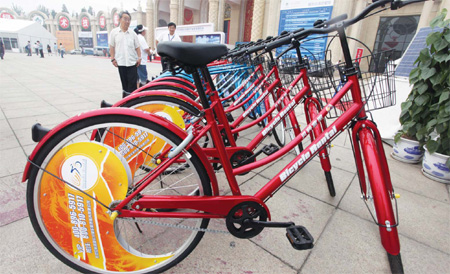
In Denmark, there are 5.5 million residents and more than 4.2 million bicycles.
But this year the wheels have turned a corner, according to the China Bicycle Association (CBA).
By the end of 2010, Chinese production numbers are expected to be up 4 million more than in 2009, showing signs of recovery, says Ma Zhongchao, chairman of the CBA.
"The bicycle industry got hit last year largely due to the financial crisis, but it's not the only reason," Ma says.
He says safety on China's crowded roads is becoming an increasing concern for cyclists, who are staying off the roads in record numbers.
According to a survey published by the Beijing Transportation Research Center, many cyclists are quitting their two-wheel machines because cars are illegally using bicycle lanes to beat traffic jams.
"Apart from safety concerns, some people believe that cars are more suitable for their social status and riding old bikes is seen as cheap and less prestigious," Ma says.
But he says new cycling trends are also emerging thanks to more recreational riding.
"Biking is now enjoying a change of face and new designs," Ma says.
"Following the emergence of new bicycle types such as mountain bikes and racing bikes, bicycles are gradually transforming from a transportation tool to an eco-friendly way of exercise and entertainment."
To encourage bicycling and reduce emissions, more policies are being employed around China for areas to become more user-friendly for riders.
After the 2008 Olympic Games, Beijing initiated a bicycle revival plan to increase the number of cycling commuters to 23 percent by 2013. One important step was to actively promote rental services outside selected subway stations along Line 4 and Line 5.
Rental points were set up every 500 meters and, by 2012, authorities hope that commuters and tourists will have access to 20,000 bicycles at 1,000 sites.
There are already a number of bike rental companies in Beijing, but not all have been successful.
Fangzhou Bicycle closed its doors in November because the company said it "lacked government support".
But two other bike rental companies in Beijing, Lantu Suobei and Yongjiu, are still operating.
Beijing public transportation officials issued a plan in August to make public bikes available for rental near subway lines by the end of this year.
It will be one of the first few times local authorities are offering public bike-lending services.
The same bicycle rental plans are being rolled out in many cities like Shanghai, Hangzhou and Shenzhen.
To help raise bicycle awareness, a grand "low-carbon China" bicycle ride was hosted by the CBA in May. Twelve cyclists embarked on a 4,300 km journey from Beijing to Shenzhen in Guangdong province. The 47-day ride covered 125 cities and spread the word to millions.
"With its eco-friendly and health-improving attributes, cycling is just in the early stages of a full-blown renaissance," Ma says.
As the world's largest exporter of bicycles, China has significantly increased shipments to many other countries and blocs over the past decade, except to the EU.
Bicycle exports to EU countries fell from 3 million units in 1992 to 720,000 in 2009, merely taking up 1.56 percent of the total export volume of Chinese bicycles.
European trade protection against Chinese bicycles dates back to 1993, when a 30.6 percent anti-dumping duty was imposed. In 2005, the EU raised it to the current level of 48.5 percent.
The EU also launched a review of the 48.5 percent tariff in July and is now in the process of deciding whether to extend the measure for five more years, following a request from the European Bicycle Manufacturers' Association.
"Without help from the government, the chance of Chinese companies winning the case is slim. After failing twice, many companies have already given up responding to the charges," says Zhang Peisheng, senior commissioner with the China Chamber of Commerce for Import and Export of Machinery and Electronic Products.
However, the EU has currently no tariff on bicycles imported from Vietnam, Bangladesh and some other Asian countries under a policy to spark economic development in these developing nations.
Guo Haiyan, vice-secretary general with the China Bicycle Association, says the "virtual embargo" of bicycles from China over the past two decades has caused losses of more than $3 billion (2.3 billion euros) to Chinese manufacturers and stripped the country of millions of jobs.
"This is unfair not only to Chinese manufacturers but also to European customers," Ma says. "They have been deprived of the right to choose a good and cheap bike and the price of a bike in Europe is almost one-third higher than in the US."
E-paper

Pearl paradise
Dreams of a 'crazy' man turned out to be a real pearler for city
Literary beacon
Venice of china
Up to the mark
European Edition

Specials

Power of profit
Western companies can learn from management practices of firms in emerging economies

Foreign-friendly skies
About a year ago, 48-year-old Roy Weinberg gave up his job with US Airways, moved to Shanghai and became a captain for China's Spring Airlines.

Plows, tough guys and real men
在这个时代,怎样才"够男人"? On the character "Man"