Focuslight is shining example for China's manufacturing sector
Updated: 2015-09-21 07:52
By Andrew Moody(China Daily)
|
|||||||||||


Those reliant on cheap labor have been forced to shift their production to countries such as Vietnam, Cambodia, Bangladesh and even African countries.
Liu at Focuslight said China can no longer engage in this so-called race to the bottom. Unlike China's earlier pioneering manufacturers, his company is not dependent on cheap labor.
Labor, in fact, only makes, up 15 percent of the company's direct product cost, when research and developments costs are excluded, compared with 60 to 65 percent for low-cost manufacturing.
Of his 300 employees, around 130 have master's or doctorate degrees.
"When I go and see customers in Europe or the US, I say that although we are located in China we are not a typical Chinese low-price company," he said.
Liu has had to go to considerable lengths to overcome this perception of Chinese manufacturing being associated with low-end technology.
"I ask them whether they have any new projects and say that we are willing to support and help them for free at the initial stage. I tell them they have nothing to lose since they can still work with our competitors in the US and Europe who will be charging them a development fee. We then prove we can produce a prototype within three months that is sometimes better or at least as good as our rivals'. This is the way we have to work," he said.
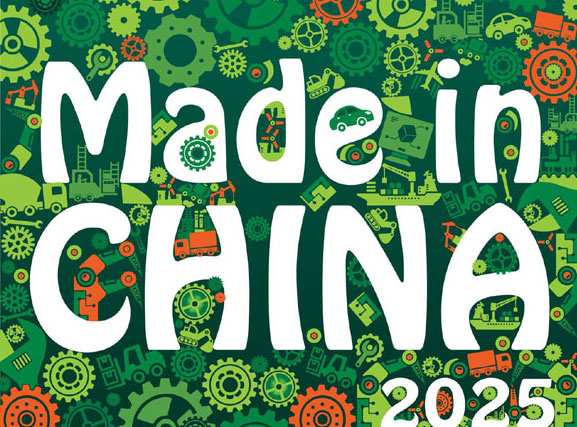
One of the aims of the 2025 strategy is to address weaknesses in research and development, product quality, dependence on low-end production, information technology and an inability to connect with global production and supply chains.
The strategy will address certain key "bottlenecks", which the government says are hampering China's economic development.
For example, China spent $220 billion last year importing integrated circuits, more than it spent buying oil around the world. The aim is for China to make such products itself.
Wu Changqi, professor of strategic management at Guanghua School of Management, said that whether the strategy is successful will depend on how it is implemented.
"I think it is important that it is not completely a top-down approach, but also involves a lot of market mechanisms. It should not just be an industrial policy offering cheap bank loans and grants to companies working in particular sectors," Wu added.
Wu said it was also important to maintain competition and not just protect domestic producers. "If you want to promote electric cars, for example, you need to have a level playing field for both Chinese and foreign companies," Wu said.
Related Stories
China seeks markets for excess capacity 2015-09-10 09:54
Added value of high-tech manufacturing rises 10.4% 2015-09-16 17:45
Ministry to make a push for big data industry 2015-09-10 14:37
Manufacturing in China needs to get smarter, says Deloitte report 2015-09-09 09:51
Internet plus strategy to help solve manufacturing overcapacity 2015-08-27 10:58
Today's Top News
Sino-French fund to invest in markets worldwide
Young people from US look forward to Xi's state visit: Survey
For marathon runners, it's time to shine
Japan enacts new security laws to overturn postwar pacifism
London forum advances soccer hopes
Vice-Premier Liu visits Europe to encourage cultural exchanges
Economy worries prompt Fed to hold rates steady
Overwhelmed by migrants, Croatia closes border with Serbia








Hot Topics
Lunar probe , China growth forecasts, Emission rules get tougher, China seen through 'colored lens', International board,
Editor's Picks

|
|


|

|
|

|