Better way to bring home the bacon
Updated: 2015-07-24 08:09
By Liu Jia(China Daily Europe)
|
|||||||||||


 |
|
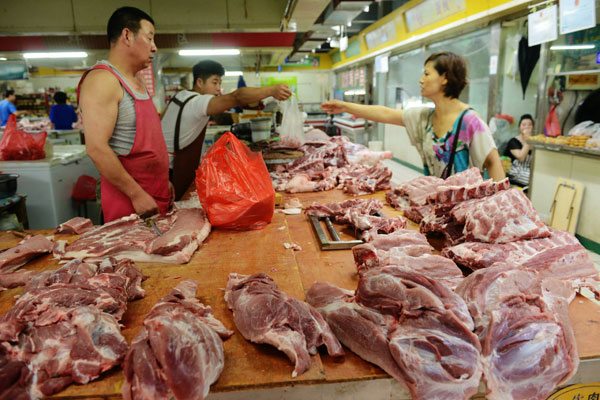
A woman buys pork at a farm produce market in East China's Shandong province. [Photo by Yu Fangping/Asianewsphoto] |
Philippe Houdart, chief veterinary officer at FASFC, says officials of the Belgian food safety agency visited China twice last year to help advance the agreement.
"We have excellent cooperation with the food sector and close relations with the Chinese authorities," Houdart says.
Belgium has some of the strictest food safety controls in the world, he says, especially after FASFC was built from scratch in the wake of the dioxin crisis of 1999. That's when animal feed in Belgium was contaminated with cancer-causing dioxin and polychlorinated biphenyls, temporarily interrupting trade with dozens of nations.
This year, CNCA officials will inspect the Belgian pork production system, with the expectation of clearing the way for more companies to begin exporting to China. Officials expect four more companies to be allowed initially to export pork to China as a result of the agreement.
A series of certifications and other methods are to be adopted to improve the level of quality control, officials say. Those measures include providing real-time and dynamic production and testing data to CNCA from companies exporting pork to China.
Belgian companies will need to be registered with and overseen by FASFC as well as comply with Chinese laws, regulations and criteria regarding hygienic conditions, according to the agreement.
In practice, through a shared information database, CNCA will have access to analysis results from pork at the registered companies in Belgium. It will recognize the FASFC export certification for Belgian pork producers and the Belgian certification system.
Not only will it enhance efficiency of regulation for imported products, it will also streamline the entire export process, officials say.
The mechanism is new - it's the first such agreement China has reached with foreign authorities on certificate registration and regulation of imported food through a shared information system.
The two sides have been working on the agreement for several years, and Belgian King Philippe has also played a role in encouraging its development. Several related agreements were signed during the king's visit to China in June.
Belgian pork producers have also hailed the arrangement.
"We hope soon our Chinese customers will benefit from the direct export of pork products from Belgium," says Dirk Nelen, CEO of Noordvlees Van Gool, the largest meat supplier in Belgium. "Maybe they can enjoy fresh Belgian pork at Chinese National Day dinner."
Nelen's company is one of the few Belgian pork producers currently exporting pork to China.
Almost 70 percent of Noordvlees' pork products are exported globally. The Chinese market now takes up between 10 and 12 percent of Noordvlees' total global market share, after Germany and Poland.
"We started exporting to China in 2011, but via Hong Kong," Nelen says. He says the company is now waiting for CNCA to complete the final administrative procedures.
Once added to the list of registered companies approved by China, Noordvlees will be eligible to export directly to the Chinese mainland. The company expects to export about 56,000 tons of pork to China a year, which will bring a turnover of $185 million to $200 million, Nelen estimates.
"China, a very important market for us, also one of the best markets, will account for 20 to 25 percent of our total global market share within two years, after we have the approval for direct export," he says.
The changes are also expected to benefit Chinese consumers.
"Without transit from Hong Kong, the delivery and shipment time will be shortened. There can be a more favorable price thanks to the reduction in costs. It will also reduce the probability of mistakes happening along the way," Nelen says.
Chinese consumers will have safer, fresher and cheaper Belgian pork and it is expected to encourage good value for consumers in the country's meat sector, thanks to the foreign competition.
Food safety is a huge issue for Chinese consumers. China has had several pork scandals in recent years, with unsafe meat being sold in shops and restaurants.
In June, customs officials in Hunan province sealed more than 100,000 metric tons of smuggled frozen meat worth up to 3 billion yuan ($483 million; 440 million euros), including frozen pork.
The National People's Congress of China promulgated an amended food safety law in April, and it will become effective on October 1.
"The 2015 Food Safety Law is regarded as the most stringent food safety regulation in the history of China," according to a report by Haynes and Boone LLP, a global law firm based in the United States.
Today's Top News
Discovery of Earth-like planet disappoints Chinese Web users
Turkish warplanes destroy IS targets
Financial Times sale – the deal no-one saw coming
Deficit hits $104b in first half
Warriors star in lakeside opera spectacular
Greek parliament passes crucial bailout bill
Astronomers discover most Earth-like planet yet
Ministry: No date set for nationwide two-child policy







Hot Topics
Lunar probe , China growth forecasts, Emission rules get tougher, China seen through 'colored lens', International board,
Editor's Picks

|

|


|
|

|
|