Prevention program continues
Updated: 2012-12-24 05:41
By Liu Jie (China Daily)
|
|||||||||||


|
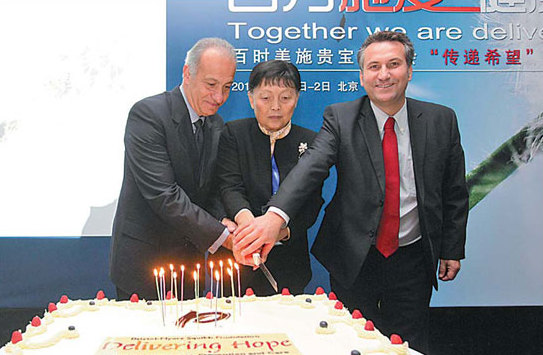
John Damonti (left), president of the Bristol-Myers Squibb Foundation, Zhang Meiying (center), president of the China Foundation for Hepatitis Prevention and Control, and Jean-Christophe Pointeau, president of BMS (China) Investment Co, celebrate the 10th anniversary of Delivering Hope, a hepatitis prevention program, in China. Provided to China Daily |
Bristol-Myers Squibb invests again in project to fight hepatitis disease
Through hepatitis control and prevention efforts over the past decade, vaccination rates of hepatitis A and hepatitis B have been on the rise annually in China, topping 90 percent in 2011, according to the latest data from the Chinese Center for Disease Control and Prevention.
The hepatitis B virus-carrying rate of infants and young children under 15 is far lower than before and the transmission rate of hepatitis B among infants and young children has declined significantly.
However, control in China still needs improvement: The Ministry of Health said that viral hepatitis still ranked first in the number of reported incidents of infections among Class A and B infectious diseases (28 diseases that are under compulsory or restricted management).
That is why Bristol-Myers Squibb, a US biopharmaceutical company, decided to continue its investment in its hepatitis prevention program in China. Furthermore, a new program on diabetes control has been launched.
With a total of $1.1 million charitable funds, about $400,000 will go to the Delivering Hope program, which was initiated by the BMS Foundation and includes 20 hepatitis prevention and control projects that cover more than 8 million people. A total of $700,000 will be devoted to the Together on Diabetes program.
The BMS Foundation plans to expand the Delivery Hope program to hepatitis C prevention in China in coming years, investing more effort and time in the rural areas of western China.
"The fundamentals of all our programs are the same. We look at issues locally and share globally," said John Damonti, president of the BMS Foundation.
With the accumulated investment of nearly $5.28 million, the Delivering Hope program targets almost all high-risk groups of hepatitis virus transmission, such as newborn babies, women of childbearing age, adolescents, migrant workers and medical workers.
The program adopts a cooperative disease prevention and control model which is managed by the government and participated in by enterprises. At the same time a variety of innovative education and publicity activities for disease prevention and control have been conducted for target groups of different types from different regions.
"The keyword for our projects is 'community' in that we want to provide a community-based education. People can learn about disease prevention and control through various interesting activities," said Damonti.
For example, there is a game of answering questions about hepatitis and the winners can get rewards from the BMS Foundation.
The BMS Foundation finds various ways to disseminate information about hepatitis prevention, such as printing tips on playing cards, on tissues or on vessels for drinking tea and offering these free of charge to people.
"Over the past decade, we have been conducting continuous close cooperation with the Bristol-Myers Squibb Foundation," said Yang Xizhong, vice-chairman and secretary-general of the China Foundation for Hepatitis Prevention and Control. "These projects are about the basic survey on viral hepatitis prevention and treatment, raising public awareness, grassroots medical staff training and education to high-risk populations. They provide good social benefits."
In 2012, the BMS Foundation decided to expand its Together on Diabetes initiative to China and India, pledging $15 million over five years to help these developing nations with rapidly growing numbers of Type II diabetes patients.
It invested $520,000 in cooperation with the Shanghai Charity Foundation, creating a diabetes management model based on the grid management of city communities, with the purpose of improving diabetes control and prevention work in communities in developed areas.
The foundation also granted $700,000 to work with the Chinese Center for Disease Control and Prevention to formulate a comprehensive intervention plan as a practical model for diabetes prevention and management in rural China.
Damonti said the care for hepatitis or diabetes patients and the effort to prevent such diseases should not be confined to doctors' surgeries. People need easy access to both the information and the medical care.
"We conducted surveys and chose the most effective strategies," said Phangisile Manciya, director of Corporate Philanthropy for Hepatitis B/C in Asia and Diabetes in China and India.
"In different countries there are different agendas. For example, the situation of hepatitis prevention in China is much better than that in India. In China, there is already a very high level of awareness of hepatitis and diabetes prevention, which facilitates our programs here," said Manciya.
Ye Yiwen contributed to this story
liujie@chinadaily.com.cn
(China Daily 12/24/2012 page22)
Today's Top News
President Xi confident in recovery from quake
H7N9 update: 104 cases, 21 deaths
Telecom workers restore links
Coal mine blast kills 18 in Jilin
Intl scholarship puts China on the map
More bird flu patients discharged
Gold loses sheen, but still a safe bet
US 'turns blind eye to human rights'








Hot Topics
Lunar probe , China growth forecasts, Emission rules get tougher, China seen through 'colored lens', International board,
Editor's Picks

|

|


|

|

|

|