Making it all work in the real world
Updated: 2012-11-09 16:22
By Zhang Haizhou (China Daily)
|
|||||||||||


Beijing Hyundai, a joint venture established about a decade ago by the South Korean carmaker, is also now in partnership with Chongqing Lixin Vocational Education Center to train workers in the required skills.
Tan Sheng, a teacher in automobile repair at Lixin, says Germany's world leading global supplier of technology and services, Bosch, and the Japanese carmaker Toyota, have also set up classes there.
"More and more such programs have been set up in China in recent years."
The increasing prevalence of such projects highlights the growing importance China attaches to vocational education, but experts say there is still a long way to go before they can meet the demand from foreign companies.
|
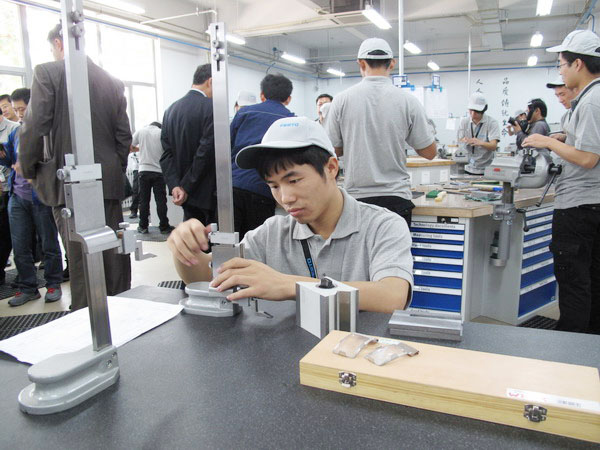 Apprentices practices at a training center of Festo (China) Production Ltd. [Photo/China Daily] |
These projects are just provisional measures taken by companies because there are no better options, says Feng Xiao, director of Tongji University's Institute of Vocational Instructors in Shanghai.
"The problem is how to address the loss of trained talent," he says, referring to the exodus of many skilled workers to other companies.
In Festo's case, apprentices have signed a contract to work at the company for at least three years after graduation.
Buschfeld, of the AHK in Shanghai, points out the limits foreign firms face when signing contracts with their apprentices. She says there is "no status of apprenticeship" in China's labor laws, so the contracts are not strictly binding.
She says this is a major challenge for her organization when promoting "dual education" in China.
Another drawback, Buschfeld says, is the perceived quality of the country's vocational training system. Normally, the better performers in the annual national college entrance exam go to universities, while those with lower grades turn to vocational colleges.
Buschfeld also sees the low respect paid to blue-collar work as a hurdle to promoting vocational education in China. In Germany, she says, many company bosses started off as apprentices.
However, she remains optimistic about promoting German-style vocational education in China, because "Chinese leaders are so open-minded" now and the "mind of the people has changed a lot".
Festo apprentice Wu is also optimistic about his future, especially since his first job is already secured.
"No matter what position I finally get here after I graduate, I'll be diligent and try my best to win promotion. Going to Germany? That will always be my target."
Cecily Liu contributed to this story.
zhanghaizhou@chinadaily.com.cn
Related Stories
Students made to work at Foxconn as interns 2012-09-07 08:01
Employment rate up for vocational school grads 2012-07-25 13:42
More funding for technical, vocational schools 2012-05-17 13:47
Help to vocational schools aids students 2012-02-28 09:31
J&J plans training center in China 2012-07-12 14:29
China learns new way to stay fed 2012-06-16 10:49
Today's Top News
President Xi confident in recovery from quake
H7N9 update: 104 cases, 21 deaths
Telecom workers restore links
Coal mine blast kills 18 in Jilin
Intl scholarship puts China on the map
More bird flu patients discharged
Gold loses sheen, but still a safe bet
US 'turns blind eye to human rights'







Hot Topics
Lunar probe , China growth forecasts, Emission rules get tougher, China seen through 'colored lens', International board,
Editor's Picks

|

|


|

|

|

|